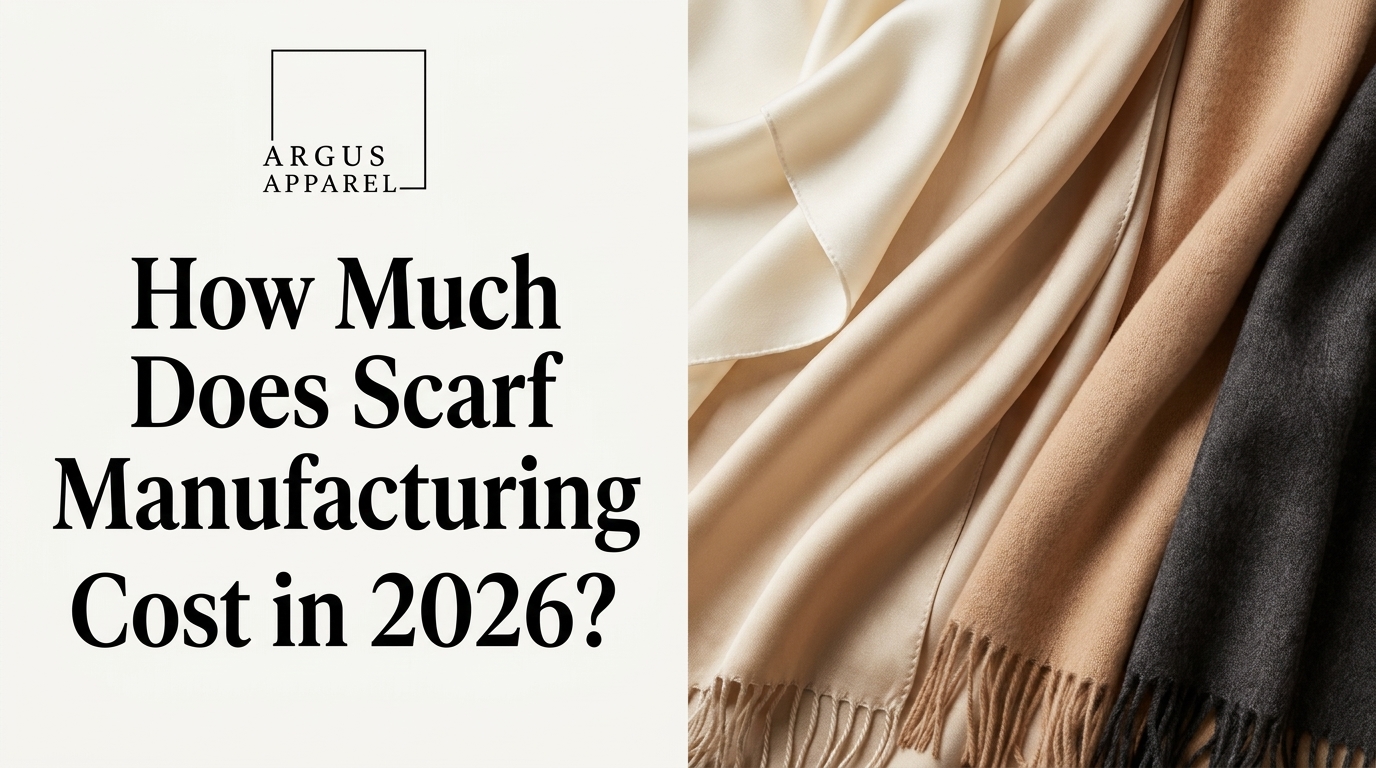
All scarves are heavy movers as a style accessory. They come and go with the seasons, serve as corporate gifts, and are featured in almost any store assortment but the actual expense to create one is as great as much as a small accessory is deceptive. Fabric, size, printing method, and order volume all shape the final number, so getting quotes from a scarf manufacturers partner without understanding these variables first usually leads to budget surprises. Understanding scarf production cost matters for any brand working in fashion accessory manufacturing, and here is what drives that number in 2026.
Average Cost to Manufacture Scarves in 2026
There are three distinct cost tiers which tend to be clearly defined. The cost of basic scarves is $2 to $5 a pop, common for simple designs that feature polyester or cotton fabric, which are made and sold at regular retailers. Mid-range scarves range about $5 to $12 and are typically made with a detail-pruned print or a mixture of viscose and other materials. Premium scarves begin at $12 and go up to $30 per unit or more, depending on the addition of silk, hand finished edges, or fancy patterns. All these then move a scarf from one tier up to the next in combination with fabric, size, printing complexity, and order quantity.
Fabric Cost Breakdown
Fabric is still the largest single expense in the manufacture of scarf. Cotton is not only affordable but versatile, as well, for casual items, to prominent promotional clothes. Polyester is even more affordable and adapts an excellent within an exceptionally vivid tint, and consequently the typical choice for copious quantities of printed scarves. The third group—viscose and rayon—provide a soft drape that falls somewhere in the middle in terms of cost. As a luxurious item, Silk is priced accordingly and has an impressive texture and sheen, which is exactly why silk scarf manufacturing cost sits well above every other fibre on this list. Wool is more expensive as well; it is usually used on winter collections where quality is more significant than fashion. Solid fabric sourcing for clothing brands relationships make it easier to secure consistent quality across whichever fibre your line depends on.
Size and Design Impact on Cost
A small scarf will be cheaper than a large scarf as more fabric equals rawer for a larger scarf. Excessive prints, especially complex ones, or unusual shapes will add processing time to the production. Shape is also important as each of square, rectangular and infinity are needed to be cut and finished in diverse ways, and the infinity scarf has even further seamed steps that a basic rectangle does not.
Printing and Customization Costs
The cost of a design is quite different between its conception and its appearance on a fabric. Digital printing offers moderate cost and is suitable for smaller orders with complex design content, primarily for use in multi-colour printing. Screen printing has benefits in terms of a lower cost at higher volume and a lack of appeal when it comes to exceptionally fine designs. Polyester is the best fabric for sublimation, as prints will appear bright and effective with outstanding colours at reasonable prices. Embroidery is used as an option on the high end, which is an excellent choice for corporate logos and branding as it conveys a higher status.
Labor and Manufacturing Costs
Scarfs absorb lots of other steps before they are ready for packaging, aside from their fabric and printing. Aside from fabric and printing, scarves undergo a variety of other steps before they can be packaged and sold cutting, stitching, hemming, and finishing. Labor cost is extremely sensitive to the location of production due to the wide regional differences of wage rates. Quality control and inspection is an additional cost – but it gets problems sorted out before they reach customers and is less expensive than managing returns.
MOQ Impact on Scarf Pricing
Lowest order quantity plays as much of a role as fabric choice does in scarf cost per unit, and this matters most for brands ordering a custom scarf cost structure built around their own branding rather than a stock design. The lower the MOQ, the more expensive the individual item will be, as the set-up costs are allocated to fewer items. Bulk pricing helps to improve the per-unit price, which is more important to repeat orders than to startups trying a modern design. Startups in particular benefit from working with low MOQ clothing manufacturers who price small runs rather than treating them as an afterthought.
Packaging and Logistics Costs
One by one packaging in simple poly bags or branded boxes, is an easy cost to under-estimate. Any branding element, such as woven labels and hang tags, will have its own line item. The most important factor is the size of the order and destination, as well as storage costs more relevant for brands that have seasonal inventories: in the middle of winter, the scarves are stored in the warehouse during the months, this is a real weight.
Cost Comparison by Scarf Type
Some fashion scarves are priced higher than others as it involves the type of fabric and complexity. During the winter months scarves can be expensive as the wool used in scarves or blends of wool and other fabrics are heavier and more suited for warmth. By nature, silk scarves are pricey, as are all other luxury fabrics made of this raw material. Promotional scarves typically have basic designs and are made of polyester fibre, making them on the lower end of the spectrum and why they reign supreme in corporate gifting programs.
Briefly:
| Scarf Type | Relative Cost | Why |
|---|---|---|
| Wool / Winter Scarves | Higher | Heavier fabric and blends built for warmth cost more per unit |
| Silk Scarves | Highest | Luxury raw material with a premium texture and sheen |
| Promotional / Polyester Scarves | Lower | Basic designs on affordable fabric, common in corporate gifting |
Hidden Costs Brands Often Miss
There are a couple of expenses that some first-time homebuyers always dread. Investing time and cash into collecting samples and/or prototyping can be time consuming and costly prior to full-scale orders but miss that step and the potential for costly mistakes in bulk orders can be present. For screen printing and embroidery digitization, design setup fees can also be a factor to consider when evaluating quotes from suppliers – this is a cost that can be easily forgotten when a comparison is made. Sometimes, much-needed reordering’s must be made because of shipping delays, and this can cost a lot of money. Seasonal scarves that only sell for a few months of the year mean that you must pay lots of money for not only the scarves but also the space to store them in.
How to Reduce Scarf Manufacturing Costs
A handful of decisions consistently protect margins on scarf production. Choosing cost-effective fabrics like polyester blends over pure silk cuts cost significantly without sacrificing print quality. Optimizing scarf size and design, rather than defaulting to oversized or extraordinarily complex patterns, keeps unit costs reasonable. Limiting complex customization to flagship products, while keeping the rest of the line simpler, controls cost across a full collection. Ordering in bulk whenever possible brings per-unit pricing down. Working with experienced manufacturers who understand these trade-offs from day one saves both money and time.
How Argus Apparel Supports Cost Optimization
Scarf manufacturing involves more moving parts than it first appears, and getting the cost structure right takes real expertise. Argus Apparel provides transparent pricing and clear guidance at every stage, so brands know exactly what is driving their per-unit cost before committing to a run. Our wide fabric sourcing options mean you are not locked into one supplier’s limited fibre selection, whether you are working in cotton, silk, wool, or polyester. Flexible MOQs support both small businesses evaluating a new accessory line and established brands placing large repeat orders. This kind of clothing manufacturing cost transparency, paired with efficient production and real quality control, is part of why brands trust Argus Apparel for scalable manufacturing beyond scarves too. Many of the same clients who start with a scarf order eventually expand into broader custom apparel manufacturing once they see how the process works.
Conclusion
Scarf manufacturing costs swing widely based on fabric, size, printing method, and order volume, but the pattern behind the pricing is consistent once you understand it. Fabric and customization carry the biggest impact on the final number, more so than most first-time buyers expect. Brands that plan for hidden costs, test with samples before scaling, and choose their fabric and MOQ strategy deliberately tend to protect their margins far better than those chasing the cheapest quote on paper. The right manufacturing partner turns that complexity into a straightforward process instead of a guessing game.