Hoodies are everywhere. They lie at the crossroad between comfort and cool, and when you scroll through a streetwear lookbook or are packing a weekend trip, you are likely to be at least wearing a hoodie. That type of universal appeal is a big opportunity to clothing brands and startups. However, before you begin to design your dream drop, you must first have a talk with yourself: how much does it really cost to make a custom hoodie?
It is costly to get that answer wrong. Underprice and you will either reduce your margins or increase prices at the most inappropriate time. Be too ambitious and you could end up not launching something that would have been popular in the market. Anyhow, it is always good to know your figures in advance and then you have the sort of clarity that simplifies everything.
Why Understanding Hoodie Production Costs Actually Matters
Many new brand founders pay all their attention to design at the initial stages – which is understandable, as that is the fun part. However, one of the most widespread pitfalls in the industry is not discussing costs and it is likely to manifest itself at the most inappropriate moment: when you are already in production.
Fabric Costs: Where It All Begins
The largest cost driver in the production of hoodies is fabric, which can accept 40 to 60 percent of your total manufacturing cost. The kind of fabric you use influences the feel of the hoodie, its longevity and how it fits on the customer body, and therefore this choice has a significant impact that is not just on the price tag.
Common Hoodie Fabrics
Cotton is the favourite of the crowd – soft, breathable, and easy to print on. It is easy to print using screen printing and is comfortable to the skin, making it a favourite among lifestyle and casual brands. The negative is that it can become small and is prone to be expensive compared to synthetic ones.
Polyester is on the other extreme. It is moisture-wicking, durable, and maintains its shape. It is also cheaper and therefore is used in performance-based or cost-effective lines. Something to remember polyester does not take dye in the same manner as cotton and therefore the printing may have a different appearance.
The option of custom hoodies is cotton-poly blends. You have the comfort of cotton and the strength and less expensive price of polyester.
The premium feel is in fleece (either cotton fleece or French terry). The brushed fleece has that warm and cozy inside that customers equate to quality. It is also more expensive, and it also retails higher, which is reasonable in the case of high streetwear or winter collections. You can explore a detailed breakdown of fabric options in this hoodie materials guide from Argus Apparel.
Fabric Weight (GSM) and Its Impact on Cost
GSM is abbreviated as grams per square meter, and it is the weight and density of fabrics used in the industry. In the case of hoodies, the lighter fabrics are normally in the 180-250 GSM range and can be used in the spring or layering fashion. The 300-420 GSM range of heavier fabrics is what provides you with that substantial, high-end hand-feel that most streetwear customers are attracted to.
The plain fact about GSM and cost here is that the more fabric you have the more material you have and the more material you have the more money it costs. Even with all things remaining constant, a heavyweight 380 GSM hoodie will always be more expensive to manufacture than a 220 GSM one. However, heavier hoodies are also likely to command higher prices at retail, so the trade-off can be rational in case the brand targets the mid-to-premium segment.
Printing and Branding Costs: How You Put Your Mark on It
After sorting the fabric, the next most important question is how you will brand the hoodie. The process you use will influence the appearance of the finished product as well as the price per unit.
Printing Methods Compared
The workhorse of hoodie branding is screen printing. It is economical at bulk, yields vivid and durable prints and stands the test of time in the laundry. It is most effective in bold graphics with few colours. The fixed cost (creating screens in every colour) implies that it will begin to shine at greater volumes.
Embroidery provides a high-end, textured appearance to a hoodie that many consumers would equate with high or heritage brands. It works best on chest patches, or sleeves. The price increases with the number of stitches, thus making large, embroidered graphics a costly affair, however, when it comes to the correct brand, it is worth the money.
Direct-to-Garment (DTG) printing is ideal in small batch and multi-colour designs. It has no set up cost and is therefore affordable to startups that are testing colourways. It is more expensive than scale screen printing and should only be used in limited drops or sampling.
Sublimation is most effective on polyester-heavy fabrics and can be printed all over. When you are thinking bold, edge-to-edge graphics, then sublimation is your technique. It does not work well on high-cotton fabrics however and therefore your fabric selection and print technique must be determined jointly.

Branding Elements Beyond the Print
The print is not the only aspect of branding a hoodie. The cost of custom woven labels, neck tags, hang tags, branded packaging, etc. all increase the overall cost, but it also increases the perceived value of the product. These details are observed by customers, particularly during the unboxing experience, and brands that invest in this are likely to lead to more repeat purchases.
Design Complexity: The More You Add, the More It Costs
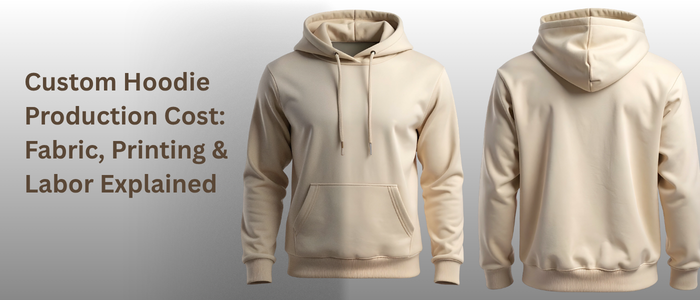
One of the cheapest things that you can make is a basic pullover hoodie with a single-color chest logo. Begin to add features – a kangaroo pocket, adjustable draw strings, contrast panels, ribbed cuffs, full-zip with custom hardware – and the cost begins to rise. Every added feature needs more material, more labour, and more attention of the production team.
Extra pattern work and extra rounds of sampling are also necessary to get oversized or custom-fitted silhouettes right. Colour blocking and panel designs with contrasting fabrics mean more cutting and more stitching. None of this renders these details a poor concept – a feature-rich, well-designed hoodie is often what warrants a higher retail price. However, you should plan to spend on it at the beginning.
Labor Costs: The Hands Behind Your Hoodie
The simplest processes of the hoodie manufacturing process – cutting pieces of fabric, sewing them, adding ribbing, drawing strings, sewing seams, etc. – all of them need professional hands. More complicated designs, use of more panels, special methods of construction or specialty finishes demand even greater skilled work and take more time to accomplish.
Local labour rates are also a factor. In general, manufacturing is more expensive in the USA compared to manufacturing in Southeast Asia or other offshore sites, but it has advantages such as faster communication, easier quality control, and shorter lead times. The trade-off is valuable to many brands, particularly in early phases when the speed of iteration is important.
One approach worth knowing about is cut and sew manufacturing, where garments are built from scratch using custom patterns rather than pre-made blanks.
Minimum Order Quantities (MOQs): The Volume Game
MOQ is an abbreviation that means minimum order quantity, and it is among the most significant numbers to know prior to contacting any manufacturer. Most factories have minimums since it is not cost effective to establish a complete production run of twenty pieces. The cost of that set up – preparation of materials, adjustment of machinery, cutting of patterns – is divided by the order, and the smaller the quantity ordered, the greater the unit cost.
Sampling and Development Costs
The cost of sampling is highly variable and depends on the complexity of the garment and the manufacturer but costs between $50 and $500 per sample. Modifications to the initial sample may accumulate, and that is why it is economical overall to provide clear and detailed tech packs early on. An effective sample approval procedure will save you the hassle of finding out that there is something wrong after five hundred units have been cut.
Shipping and Logistics: The Cost That Catches People Off Guard
Shipping is not a consideration in production budgets, yet it can have a significant impact on your per-unit cost, particularly when it comes to international orders. The freight prices are based on the weight, volume, destination, and shipping mode; sea freight is more affordable and slower whereas air freight is quick and costly.
In-country production clearly saves on freight expenses and shortens lead times. Customs considerations are also less, making it easier to do so with brands that are still trying to get their coordination in order. Your true per-unit cost should include packaging and handling costs, rush order premiums, and import duties in case of international manufacturing.
Hoodie Cost Breakdown briefly
| Cost Component | Budget Range | Mid-Range | Premium |
|---|---|---|---|
| Fabric (per unit) | $3 – $6 | $6 – $10 | $10 – $18+ |
| Printing / Branding | $1 – $3 | $3 – $6 | $6 – $15+ |
| Labor (per unit) | $2 – $4 | $4 – $8 | $8 – $15+ |
| Sampling & Dev | $50 – $100 | $100 – $200 | $200 – $500+ |
| Shipping (per unit) | $1 – $2 | $2 – $4 | $4 – $8+ |
Cost vs. Quality: Finding the Right Balance
Chasing the lowest price per unit is one of the most common mistakes in apparel manufacturing. Brands that cut costs on fabric or labour early on often end up with products that look fine in photos but fall apart after three washes — and that is a brand reputation problem that costs far more to fix than the savings were worth.
Premium materials and skilled construction create a product that speaks for itself. Customers feel the difference between a 180 GSM hoodie and a 360 GSM one the moment they pick it up.
How Argus Apparel Approaches Hoodie Manufacturing
Argus Apparel is a Los Angeles-based custom clothing manufacturer that works with brands across every stage — from startups producing their first 50-piece drop to growing labels scaling into the thousands. Their approach to hoodie manufacturing is built around transparency, flexibility, and consistent quality.
On the fabric side, they source materials that match your brand’s positioning — whether that is a lightweight French terry for a minimalist label or a heavy brushed fleece for a premium streetwear collection. Their team walks you through GSM options, fabric comparisons, and printing methods so you are making informed choices rather than guessing.
For brands that want complete control over fit and construction, Argus also offers private label clothing manufacturing, which means you own the design, the specs, and the branding — from the stitching to the hang tag. Private label clothing production at Argus includes full-package support: tech pack development, fabric sourcing, sampling, production, and delivery.
Final Thoughts: Know Your Numbers Before You Start
Custom hoodie production is not a mystery once you understand its moving parts. Fabric choice, GSM, printing method, design complexity, labour, sampling, and shipping — each of these plays a role in your final cost, and each one is a decision you can make strategically rather than reactively.