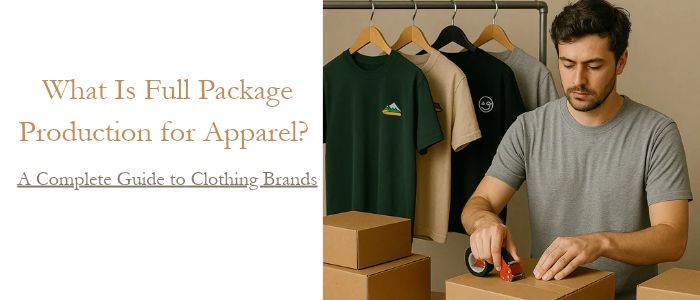
Full package production means one clothing manufacturer manages your entire order. They buy the fabric. They cut the patterns. They sew the garments, stitch in your labels, fold everything into polybags, and ship the cartons to your warehouse.
You hand over a design. You get finished product back.
That sounds simple. The reason it matters is less obvious, and it comes down to vendor count.
Most people starting a clothing line never picture how many separate companies sit behind one hoodie.
- There’s the knitting mill
- The dye house
- The trim supplier for zippers and drawing cards
- The woven label vendor
- The pattern maker
- The sewing floor
- The screen printer
- The packaging supplier
- The freight forwarder.
That’s nine companies, nine invoices, nine deposit payments, and nine chances for your launch date to slip.
Full package production, shortened to FPP, puts all of that behind one contact and one quote.
What Is Full Package Production (FPP)?
Full package production is a manufacturing model where the factory owns every stage of making your garment, from fabric purchase through to the shipped carton. Some people in the trade call it FPP, full package manufacturing, or fully factored production. The three terms mean the same thing.
The factory quotes you one price per finished unit. That price already has fabric, trim, labor, labels, packaging, and overhead baked into it.
How FPP differs from CMT
Cut, make, and trim are the other main models, and the difference is money and responsibility.
Under CMT, you buy the fabric yourself. You buy zippers, elastics, thread, and labels. You ship all of it to the factory with your approved patterns. The factory charges you for labor only. They cut, sew, and finish what you sent.
If the fabric shrinks 3% in washing, that’s your problem. If the mill ships 400 yards when you need 600, that’s your problem too. The sewing floor just runs what arrives.
FPP flips that. The factory buys the fabric, so the factory carries the risk when a mill runs late, or a dye lot comes back off shade. They’re also the ones who must fix it.
Why brands moved toward it
Two things pushed FPP into the mainstream.
First, direct-to-consumer brands got smaller and leaner. A three-person team selling on Shopify doesn’t have a production manager who can chase a trim supplier in Guangzhou. They need someone else holding that rope.
Second, textile mills raised their minimums. Most mills won’t sell fabric under 1,000 to 3,000 yards per color.
A brand making 200 hoodies can’t hit that on its own. A full package factory can, because it buys across many clients at once and gets you a cut of a larger roll.
What Services Are Included in Full Package Production?
A full package quote should cover fourteen jobs. Ask any factory to confirm all fourteen in writing before you pay a deposit, because the gaps are where surprise invoices come from.
- Product consultation
A short working session on what you’re making, who buys it, what retail price you need, and what margin that leaves. A good factory will tell you when your target cost doesn’t match your fabric choice. That conversation saves months.
- Design assistance
Sketches turned into flat technical drawings. If you’ve got reference photos and a mood board but no CAD files, this is the step that fills the gap.
- Tech pack development or review
The tech pack is the build document for your garment. Measurements at every point of measure, stitch types, seam allowances, fabric specs, trim codes, label placement, care symbols, and a bill of materials. No factory can quote accurately without one.
- Fabric sourcing
Matching your hand feel and weight target to a real mill that can supply it at your volume. Expect swatch cards before anything gets ordered.
- Trim and accessories sourcing
Zippers, buttons, drawcords, elastic, snaps, eyelets, thread, interlining. Each one has its own supplier and its own lead time.
- Pattern making
Your design translated into cutting pieces, with seam allowance and ease built in. Digital patterns beat paper because they grade cleanly and reorder years later without redrafting.
- Sample development
The physical garment you hold, wear, and criticize. First comes a proto sample for shape, then a fit sample, then a pre-production sample in the real fabric and real trims.
- Size grading
Your approved base size is stepped up and down across the full run, from XS to 3XL. Grading rules differ by body zone, so sleeve length and chest don’t grow at the same rate.
- Fabric testing
Shrinkage, colorfastness to washing and rubbing, pilling resistance, GSM verification, and seam strength. Skip this, and you learn about shrinkage from your customers.
- Bulk production
Marker making, fabric relaxing, spreading, cutting, bundling, sewing lines and finishing.
- Quality assurance
Inline checks during sewing and a final random inspection against an AQL standard before cartons close.
- Private label branding
Woven neck labels, printed care and content labels, size tabs, hang tags, heat transfers, and custom hardware.
- Packaging
Poly bags, tissue, retail boxes, mailers, barcode stickers, and carton marking.
- Shipping and logistics
Carton consolidation, export documents, sea or air freight booking, customs paperwork, and delivery to your warehouse or third-party fulfillment center.
How the Full Package Production Process Works
Eight steps, start to finish. Plan for 14 to 22 weeks from first call to goods in your warehouse. Rush programs can land closer to 10 weeks when the fabric is already in stock, but that’s the exception rather than the rule.
Step 1: Initial consultation and brand discovery
About one week.
The factory asks what you’re building, who you’re selling to, what you want to charge and how many units you can afford to sit on. You share reference garments, sketches, and any sales history you have.
Bring a target landed cost to this call. A brand that wants a $19 blank-market price and a 380 GSM French terry with embroidery is going to hear no, and it’s better to hear it now.
Step 2: Design and tech pack development
One to three weeks.
Your tech pack gets built or audited. Points of measure are set, construction is spelled out, and the bill of materials lists every component down to the thread ticket number.
This step decides your quote accuracy more than any other. Vague tech packs produce padded prices because the factory prices in the risk of guessing wrong.
Step 3: Fabric and trim sourcing
Two to four weeks.
The sourcing team pulls swatches against your weight, stretch, hand, and color targets. You approve a lab dip for each color. Trims get selected and sampled at the same time, since a custom zipper pull can take longer than the fabric.
Fabric availability is where most timelines break. Ask whether your fabric is a stock article or a mill-run order before you sign off.
Step 4: Pattern making and sample development
Two to four weeks.
Patterns are drafted digitally, and a proto sample gets sewn, sometimes in a stand-in fabric just to check the shape. Then comes a fit sample in the correct material.
Step 5: Sample review and revisions
Two to six weeks, depending on how many rounds you need.
You try it on a fit model, mark what’s wrong, and send comments back. Sleeve too short. Hood too shallow. Neck ribs too tight. Two to three rounds are normal, and each round adds a week or more.
The round that counts is the pre-production sample, made in bulk fabric with bulk trims on the same line that will run your order. Approve that one in writing. It becomes the reference every inspector measures against.
Step 6: Bulk production
Four to ten weeks.
Fabric gets inspected, relaxed, and spread. Markers are laid to squeeze the most pieces from each yard. The cutter runs, bundles move to the sewing lines, and operators work station by station.
Most factories ask for a 30 to 50% deposit before cutting starts, with the balance due against shipping documents.
Step 7: Quality control, branding, and packaging
One to two weeks.
Inspectors check seams, measurements, label placement, print registration, and shade consistency while the line runs, then pull a random sample at the end against an AQL standard. AQL 2.5 for major defects and 4.0 for minor defects is the common benchmark for apparel.
Approved units get pressed, tagged, bagged, and packed to your carton spec.
Step 8: Shipping and delivery
One to six weeks.
Air freight runs five to ten days and costs several times more. Sea freight runs three to six weeks depending on the lane. Your factory manages export paperwork, commercial invoices, packing lists, and the certificate of origin.
Add a buffer of two to three weeks to whatever you’re quoted. Mills slip, holidays close factories, and ports back up.
Benefits of Full Package Production
- One partner instead of nine
One contract, one point of contact, one deposit schedule. When something goes wrong, there’s no finger-pointing between the mill and the sewing floor, because they answer the same project manager.
- Faster answers
A question about shrinkage gets answered by the team that bought the fabric and sewed the garment. Under CMT, the same question bounces between three companies for a week.
- Steadier quality across reorders
The factory keeps your patterns, your graded nest, your approved lab dips, and your pre-production sample on file. Reorder in eight months and batch two matches batch one.
- Less risk sitting on you
If a dye lot comes back wrong, the factory eats the cost of redyeing. Under CMT, you already paid the mill, so that loss is yours.
- Lighter workload
No production manager salary. No 2 a.m. calls about trim shortages. Small teams get their hours back for marketing and sales, which is where their money comes from.
- Quicker launches
Sourcing, pattern work, and trim development run at the same time instead of one after another. That overlaps alone cuts weeks off a first order.
- Fewer moving parts in your supply chain
One purchase order covers fabric, labor, trims, labels, and packaging.
- Cleaner cost planning
A landed cost per unit, quoted upfront, beats stitching together a dozen invoices after the fact and discovering your margin disappeared.
- Room to grow
Going from 300 units to 3,000 doesn’t mean finding new suppliers. The factory already has mill relationships that stretch.
Looking for a reliable full package clothing manufacturer? Argus Apparel handles product development, fabric sourcing, sampling, bulk production, private label branding, packaging, and worldwide delivery. Contact our team to talk about your project.
Potential Challenges of Full Package Production
FPP isn’t the right answer for everyone, and any factory that pretends otherwise is selling you something.
- More cash upfront
You’re funding fabric, trims, and labor in one go. Development runs $300 to $1,500 per style before bulk even starts, and bulk deposits land at 30 to 50%. A 500-unit hoodie order can tie up $5,000 to $10,000 for three months.
What helps: split your launch across fewer styles and more sizes. Three styles done properly beat eight styles done thin.
- Picking the wrong factory hurts more
Under CMT, a bad sewing floor costs you labor. Under FPP, a bad factory controls your fabric, your trims, your quality checks, and your shipping. The downside is bigger.
What helps: ask for references in your product category, request a sample before committing to bulk, and check whether they make your garment type. A factory strong in knit tees may be weak at swimwear.
- Sampling takes longer than people expect
Two to three rounds across six weeks surprises brands who thought samples took days. Each revision means new patterns, a new cut, and a new sew.
What helps: arrive with a complete tech pack and a reference garment you already like the fit of. Both cut rounds dramatically.
- Minimums apply
Because the factory buys fabric, mill minimums flow down to you. Figure 50 to 300 units per style for domestic small-batch shops, and 300 to 1,000 per style and color for most overseas full package programs.
What helps: run one fabric across several styles, or several colors inside one fabric order, so you reach the mill minimum without carrying dead stock.
- You must stay reachable
Lab dip approvals, fit comments, and sample signoffs all wait on you. A week of silence on a lab dip is a week added to your delivery date.
What helps: agree on a response window at kickoff and name one decisionmaker on your side.
Full Package Production vs. CMT Manufacturing
The short version: FPP costs more per unit and far less in your time. CMT costs less per unit and eats your calendar.
| Comparison Factor | Full Package Production | CMT Manufacturing |
|---|---|---|
| Design Support | Factory can develop or correct designs | You supply finished designs |
| Tech Pack | Built or audited by the factory | You supply a production-ready pack |
| Fabric Sourcing | Factory sources and buys | You source, buy, and ship it in |
| Trim Sourcing | Factory manages all trims | You supply every trim |
| Pattern Making | Included | You supply graded patterns |
| Sampling | Factory manages all sampling rounds | You pay separately, sometimes through another provider |
| Bulk Production | Included | Included |
| Quality Control | Factory inspects to an AQL standard | You arrange your own inspection |
| Branding and Labels | Factory sources and applies them | You supply labels and tags |
| Packaging | Included according to your specifications | You supply or arrange it |
| Shipping | Factory books freight and prepares export documents | You book your own freight |
| Cost per Unit | Higher, with sourcing and management built in | Lower, generally covering labor only |
| Total Cash Outlay | One coordinated payment schedule | Multiple payments to separate vendors |
| Who Carries the Risk? | The factory manages its agreed responsibilities | You coordinate and manage more production responsibilities |
| Brand Involvement | Approvals at each production stage | Daily management across vendors |
| Best For | Startups, DTC brands, small teams, and businesses without a production manager | Brands with in-house production staff and established mill relationships |
Which one fits you
Choose FPP if you’re launching, if nobody on your team has run production before, or if your time is better spent selling than chasing suppliers.
Choose CMT if you already have mill accounts, a production manager, and graded patterns on file. At volume, the savings on sourcing markup are real.
Need a quote on your first run? Send your tech pack, sketches, or reference samples to Argus Apparel, and the team will come back with fabric options, minimums, and a landed cost per unit. Start your project.
Who Should Choose Full Package Production?
Fashion startups launching a first collection with no supplier network and no production hire.
Established clothing brands adding a category they haven’t made before, like a denim brand moving into outerwear.
Ecommerce and DTC sellers who need steady reorders and matching quality batch after batch, because returns kill margin on repeat customers.
Boutique retailers build a private label line beside the brands they stock.
Influencers and creators launching merch, where speed and a clean finish matter more than shaving thirty cents off a unit.
Sportswear and activewear brands working with performance knits, bonded seams, and moisture management, where fabric knowledge is the whole game.
Corporate and uniform buyers who need consistent sizing, color matching, and repeat orders over several years.
Industries That Benefit from FPP
- Streetwear
Heavy fleece, boxy blocks, oversized fits, and garment dyeing. Weight consistency across a run is the thing buyers notice first.
- Sportswear and activewear
Four-way stretch knits, flatlock seams, gusseted panels, and sublimation printing. Fabric performance claims need lab testing to back them up.
- Swimwear
Chlorine-resistant fabric, power mesh lining, bar tacking at stress points and gold-standard colorfastness. Trim corrodes if the hardware is wrong.
- Lingerie and underwear
Narrow elastics, molded cups, underwire channeling, and tiny tolerances. A quarter inch off in a band ruins the fit.
- Uniforms and workwear
Durability testing, soil release finishes, reinforced stress points, and repeat sizing across hundreds of staff.
- Luxury apparel
Hand finishing, pattern matching across seams, premium interlinings, and low unit counts with high scrutiny.
- Children’s clothing
Flammability rules under 16 CFR 1610, lead, and phthalate limits under CPSIA, drawstring safety per ASTM F1816, and third-party lab testing before anything ships to a US buyer.
- Corporate apparel
Brand color matches Pantone, embroidery digitizing, and bulk stock programs with staged releases.
Why Choose Argus Apparel for Full Package Production?
Argus Apparel works out of Los Angeles and runs full package programs for startups, designers, and growing labels across the US and abroad.
- Product development from a sketch
You don’t need CAD files or a finished tech pack to start. Bring photos, a reference garment, or a rough drawing, and the development team will build the specs with you.
- A sourcing team with mill access
Fabric and trim options match your weight, stretch, hand, and price target, with swatches and lab dips before anything gets ordered.
- Low minimums for new brands
Small-batch runs are available so you can evaluate styles without committing to thousands of units. Minimums move by fabric and garment type, so ask for yours on the specific style you’re making.
- Quality control at every stage
Inline inspection during sewing plus a final check on stitching, measurements, branding placement, and finish before cartons are sealed.
- Private label and custom branding
Woven labels, care labels, hang tags, custom embroidery, screen printing, sublimation, and branded packaging bags.
- A wide product range under one roof
T-shirts, hoodies, sweatshirts, jeans, swimwear, sportswear, uniforms, bras, leggings, and more, including cut and sew work.
- Worldwide shipping
Freight booking, export documents, and delivery to your warehouse or fulfillment partner.
- One project manager on your account
The same person from the first call through to the shipping notice, so you’re never re-explaining your order.
Frequently Asked Questions
What is full package production?
Full package production is a manufacturing model where one apparel factory manages every stage of your order: design support, tech packs, fabric and trim sourcing, pattern making, sampling, grading, bulk production, quality control, private labeling, packaging, and shipping. You get a single quote per finished unit.
What does FPP include?
FPP covers fourteen core services: product consultation, design help, tech pack work, fabric sourcing, trim sourcing, pattern making, sample development, size grading, fabric testing, bulk production, quality assurance, private label branding, packaging, and freight. Confirm the exact list in writing since coverage varies by factory.
What is the difference between FPP and CMT?
FPP means the factory buys the fabric and trims and manages the whole process. CMT means you buy and ship all materials yourself, and the factory charges for cutting, sewing, and finishing only. FPP costs more per unit and carries more of your risk. CMT costs less per unit and demands far more of your time.
Is full package production good for startups?
Yes, for most of them. New brands rarely have mill accounts, graded patterns, or a production manager. FPP supplies all three. The trade-off is a higher per-unit price and more cash committed upfront.
What is the MOQ for full package production?
Minimums run 50 to 300 units per style at domestic small-batch factories, and 300 to 1,000 units per style and color at most overseas full package programs. The driver is fabric: mills rarely sell under 1,000 to 3,000 yards per color. Running one fabric across several styles helps you clear that minimum.
How long does full package production take?
Plan on 14 to 22 weeks from first consultation to delivered goods. Sampling takes two to six weeks, bulk production four to ten weeks, and shipping anywhere from one week by air to six weeks by sea. In-stock fabric and a clean tech pack can pull that under 12 weeks.
Can I supply my own fabric?
Most full package factories accept buyer-supplied fabric, and the arrangement sits somewhere between FPP and CMT. Expect the factory to evaluate your material first and to exclude fabric performance from any quality guarantee, since they didn’t source it.
Does FPP include packaging?
Yes. Poly bags, tissues, hang tags, retail boxes, mailers, barcode labels, and carton marking are standard parts of a full package quote. Custom printed packaging is quoted separately and needs its own lead time.
Does Argus Apparel provide tech pack development?
Yes. The team builds tech packs from sketches, photos, or reference garments, and audits existing packs before quoting. A complete tech pack means a tighter price and fewer sample rounds.
Can you manufacture custom apparel?
Yes. Argus Apparel runs custom cut-and-sew work across knitwear, denim, swimwear, sportswear, lingerie, uniforms, and accessories, with embroidery, screen printing, and sublimation available in-house.
Getting Started
Most first orders fail for boring reasons. A tech pack with missing measurements. A fabric nobody evaluated for shrinkage. A lab dip that sat unapproved for two weeks. None of those are glamorous problems, and all of them are avoidable with a factory that catches them early.
That’s what you’re paying for with full package production. Not just sewing, but someone watching the parts you don’t know yet.
Ready to start your clothing line? Argus Apparel provides full package apparel manufacturing from product development and fabric sourcing through bulk production, branding, packaging, and worldwide delivery. Call (747) 298-5882, email sales@argusapparel.com, or send us your project details, and the team will come back with fabric options, minimums, and pricing.