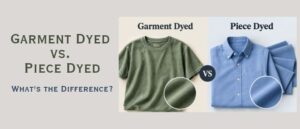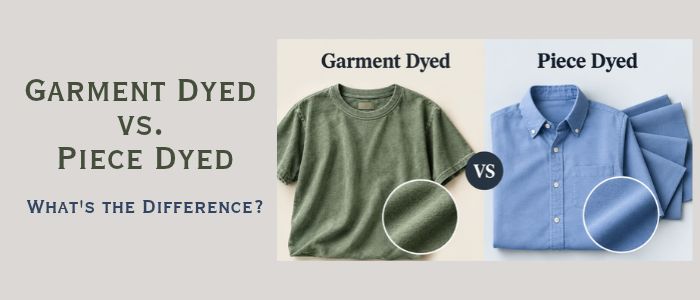
Two hoodies can come off the same fabric roll, get sewn by the same operators, and still look like they belong to different brands. The difference comes down to when the color went in.
Dyeing changes how a garment feels, how the color ages, what you pay per piece, and how long you wait. A faded, lived-in sweatshirt reads as premium. A blotchy uniform polo reads as cheap.
We’re Argus Apparel, a custom apparel manufacturer running both processes. Here’s how they differ on the floor, in cost, and in the finished product.
What Is Garment Dyeing?
Garment dyeing means the clothing is cut and sewn first, then dyed as a finished piece. Dye soaks into the fabric, the thread, and the seams at once. The undyed blanks are called PFD or RFD goods, short for prepared for dye and ready for dye.
Finished garments load into a paddle machine or rotary drum, where tumbling through the dye liquor is what gives the fabric its character. Two dye families dominate:
- Pigment dyes sit on the fiber surface, held by a binder. They fade at seams and high points from day one, which is why streetwear brands ask for them.
- Reactive dyes bond chemically with cotton. Color sits deeper and holds better in the wash, with less of the vintage effect.
Cotton is the backbone: jersey for tees, fleece and French terry for hoodies, twill, and canvas for workwear. Polyester is the problem child because it needs disperse dyes at high temperatures and comes out near white in a cotton bath.

Why thread and trims decide the result
Everything in the garment gets dyed, not just the body fabric. Cotton thread vanishes into the seam. Polyester thread stays white and gives you contrast stitching. Labels, drawcords, zipper tape, and elastic behave the same way, and metal hardware can tarnish in a hot bath.
We spec dyeable trims at development, because there’s no fixing a tarnished zipper on 2,000 finished hoodies. The payoff is slightly uneven color at seams and cuffs, a softer hand, and natural variation piece to piece. Garment-dyed t-shirts and garment-dyed hoodies are the two biggest categories we produce this way.
What Is Piece Dyeing?
Piece dyeing means the fabric is dyed as a roll before anyone cuts a pattern. The mill dyes it, finishes it, and ships it to the cut-and-sew factory ready to become garments. Most clothing on earth is made this way.
Fabric is knitted or woven, scoured and bleached, then dyed in a jet machine, a jigger, or a continuous pad range. Finishing follows compacting for knits, sanforizing for wovens, heat setting if there’s elastane. Only then does it reach the cutting table, where every panel comes off in the final color.
A jet machine runs at a lower liquor ratio than a paddle machine, so dyeing a roll uses less water, chemistry, and energy per kilogram. Fabric also moves under controlled tension, so color lands’ end to end evenly.
Fabric arrives in shade lots, each with its own color standard. Cutters sort plies by lot so the front, back and sleeves of one garment all match. That discipline is why a 10,000-piece polo order can look identical across every box, and why uniform programs, sportswear, and piece-dyed retail bulk buys depend on it.
Garment Dyed vs. Piece Dyed: Quick Comparison
| Feature | Garment Dyed | Piece Dyed |
|---|---|---|
| Dyeing stage | After sewing | Before cutting |
| Appearance | Vintage, washed, slightly uneven | Clean and uniform |
| Color variation | Natural variation piece to piece | Highly consistent |
| Fabric feels | Softer, broken-in | Standard mills finish |
| MOQ | Lower, dye-to-order | Suits larger runs |
| Cost per piece | Higher | Lower |
| Lead time | Longer, dyeing sits at the end | Faster, dyeing runs upstream |
| Shrinkage risk | Managed by oversized patterns | Managed at fabric finishing |
| Color matching | Close match, not exact | Tight match to a standard |
| Repeat orders | Expect shade movement | Reliable repeats |
| Best for | Premium fashion, streetwear | Mass production, uniforms |
Garment dyeing colors are finished pieces and give you character, softness, and small-batch freedom at a higher price. Piece dyeing colors the fabric roll and gives you flat, repeatable color, cheaper and faster.
A quick way to decide: if a shade shift between two pieces upsets your customer, go piece dyed. If a shade shift is part of what you’re selling, go garment dyed.
How Garment Dyeing Works
Nine stages. Color arrives at stage five, which is what makes everything before it different from normal production.
- Fabric sourcing: Greige or PFD fabric, no color, no optical brighteners.
- Pattern development: Patterns scaled up for shrinkage, often 6% to 8% longer in the body.
- Cutting: Standard marker making and spreading, except every panel is raw white.
- Sewing: Full assembly with dyeable thread, labels, and trims.
- Dyeing: Temperature, thyme, salt, alkali, and dye concentration follow a recipe matched to an approved lab dip.
- Washing: Rinsing pulls out unfixed dye. Rush it, and the garment bleeds in the customer’s first home wash.
- Drying: Where the real shrinkage happens, so time and temperature get controlled tightly.
- Finishing: Softeners, enzyme washes, pressing, any extra wash effects.
- Inspection: Shade grading, measurement checks, and a look for dye spots and abrasion marks.
Four things decide whether it works: dye penetration, since thick seams hold more layers and under dyed seams are the common defect; shrinkage control, since cotton can lose 5% to 10% in length; wash testing, where AATCC 61 covers colorfastness and AATCC 135 covers shrinkage after home laundering; and color consistency, managed by setting a tolerance and grading garments into shade bands.
How Piece Dyeing Works
Five stages, with color at stage two. Everything downstream is normal cut-and-sew manufacturing.
- Fabric production: Yarn knitted or woven into greige fabric, then scoured and bleached.
- Dyeing the rolls: Jet machine, jigger, or continuous pad-steam range.
- Cutting: Dyed, shrink-controlled fabric is spread and cut in the final color.
- Sewing: Assembly runs at full speed with matched thread and finished trims.
- Finishing: Pressing, tagging, folding, polybagging, straight to packing.
Running 3,000 kilograms through a jet machine is one scheduling decision. The same weight as finished garments take many loads and far more floor time.
Dyed fabric also gets inspected before cutting, so a flaw costs you fabric only, whereas the same defect found after sewing costs thread, labor, and trims as well.
The tradeoff nobody mentions piece dyeing locks your color early. Once 4,000 meters are dyed teal, that fabric is teal. Garment dyeing lets you hold undyed blanks and decide color closer to demand.
Advantages of Garment Dyeing
- Premium appearance
Slight unevenness at seams and cuffs gives a new garment the look of something already owned, and shoppers pay more for it.
- Softer texture
Hours of wet processing and tumbling soften cotton in a way no finishing chemical fully copies.
- Rich color depth
Reactive dyeing saturates the whole piece, thread and seams included.
- Fashion flexibility
One hoodie body can become five colors across a season with no fabric committed up front.
- Better customization
Dip dye, tie dye, ombré, acid wash, and overdye all live at the garment stage.
- Lower MOQs
Dying a 300-piece batch is normal. Asking a mill to dye 300 meters of custom color rarely is.
Advantages of Piece Dyeing
- Cost per piece
Fewer wet steps, less water and energy per kilogram, no handling after sewing.
- Color accuracy
Mills dye to a lab dip and verify with a spectrophotometer. If your brand color is locked to a Pantone reference, this is the process that respects it.
- Faster production
Dying runs while patterns and production slots are still being arranged, so it doesn’t extend the back end of the schedule.
- Volume handling
A mill can dye 10,000 meters in a handful of lots and document shade continuity across all of them.
- Less waste
Defects are caught at the fabric stage when they only cost fabric.
- Reliable repeats
Reorder six months later the same recipe and the fabric comes back close. Garment dyeing can’t promise that which is why private label clothing programs and uniform contracts start here.
Garment Dyed vs. Piece Dyed: Cost Comparison
Garment dyeing costs more per piece. How much more depends on eight variables, and anyone quoting a flat percentage without seeing your tech pack is guessing.
- Fabric type: Dyeing is priced by weight, so a 400 GSM fleece hoodie costs far more than a 150 GSM tee.
- Dye type: Reactive dyes need salt, soda ash, and longer cycles than pigment dyes.
- Production volume: A 200-piece run and a 2,000-piece run can take the same machine time.
- Washing treatments: Enzyme, stone, silicone, and mineral washes each add a cycle.
- Labor: Garment-dyed goods get loaded, shade-sorted, pressed, and reinspected.
- MOQ structure: Each color needs its own dye lot, so splitting volume hurts.
- Sampling: Lab dips, wash trials, and shrinkage tests since the pattern depends on the result.
- Finishing: Garment dyed pieces come out creased and take longer to press.
Which Dyeing Method Lasts Longer?
Piece-dyed garments hold their original color longer. Garment dyed pieces, done with reactive dyes, and washed properly, last just as long physically but change appearance as they age.
Color retention: Mill dyeing applies dye under controlled tension with thorough after-washing, so fixation rates are high. A tumbling drum is less even, and pigment dyes are built to release color over time.
Wash durability: A reactive garment-dyed hoodie survives dozens of washes. A pigment-dyed one visibly lightens within ten to fifteen washes, which is the product working as intended.
How they age: Piece-dyed fabric fades evenly, so an older garment just looks tired. Garment dyed pieces fade at seams and hems first, which reads as character. Hours of agitation can also cause pilling or torque if the fabric is weak.
What decides longevity isn’t the method; it’s the controls: fixation rate, rinsing, pH neutralization, colorfastness testing, and shrinkage verification. The process sets the look; quality control sets the lifespan.
Which Dyeing Method Is Best for Your Brand?
Match the method to what you sell, not to what looks good on a mood board. Three questions: what do your customers expect, what volume are you running, and what does your retail price support?
| Brand Type | Recommended Method | Why |
|---|---|---|
| Streetwear | Garment dyed | Washed look is the product; lower MOQs suit drops |
| Luxury fashion | Garment dyed | Hand feel and color depth justify the price point |
| Boutique brands | Garment dyed | Small runs, distinct product, higher margins |
| Premium basics | Garment dyed | Softness is the selling point |
| Corporate apparel | Piece dyed | Brand colors must match across every order |
| School uniforms | Piece dyed | High volume, tight budget, strict color rules |
| Promotional apparel | Piece dyed | Price-led, large quantities, fast turnaround |
| Sportswear | Piece dyed | Synthetic fabrics need mill-level dye control |
| Large retail orders | Piece dyed | Shade consistency across stores and reorders |
Pick by budget and volume
- Under 500 pieces per color: Garment dyeing is the only realistic custom color route, since mills rarely run small custom fabric lots.
- 500 to 2,000 pieces: Both work. Look, and retail price decide it.
- 2,000 to 10,000 pieces: Piece dyeing pulls ahead on cost unless the washed look is central to the brand.
- Over 10,000 pieces: Piece dyeing, with garment dyeing reserved for a capsule above the core range.
You don’t have to choose once. Plenty of our clients run a piece-dyed core program and use garment dyeing for seasonal drops.
Common Mistakes When Choosing a Dyeing Method
Seven mistakes account for most of the dyeing disasters we get called in to fix.
- Choosing on price alone: The cheaper garment costs you sales when a washed-look competitor sits beside it at the same price.
- Ignoring shrinkage: Patterns not scaled up first means a medium hoodie comes back fitting like a small.
- Skipping wash testing: Two weeks of wash trials are cheaper than a shipment that bleeds in customers’ machines.
- Picking the wrong fabric: A 60/40 cotton-poly blend sent for garment dyeing comes back chalky.
- Poor color planning: Eight colors at tiny quantities multiply dye lots, setup charges, and lab dips.
- Overlooking MOQ reality: Running 150 pieces through a machine built for 800 means paying for space.
- Not approving samples: Screens lie. Approve a lab dip and a sewn sample under daylight and store lighting.
The costliest mistake is picking the manufacturer after picking the process. A factory that only runs piece dyeing will recommend piece dyeing every time.
Industries That Prefer Garment Dyeing
- Streetwear: Heavyweight tees and boxy hoodies in washed earth tones are the category standard.
- Luxury fashion: Italian and Japanese makers have used it for decades on knitwear and chinos.
- Lifestyle and heritage brands: Surf, skating, outdoor and workwear labels want products that look broken in.
- Premium basics: When a tee sells for $50 with no graphic, the fabric and finish carry the price.
- Designer collections: Low MOQs let a designer test unusual colors.
- Direct-to-consumer brands: Dyeing to demand keeps cash out of dead inventory.
Industries That Prefer Piece Dyeing
- Uniforms and corporate apparel: A polo reordered next year must match last year’s.
- Sportswear: Polyester performance fabric needs disperse dyes at the mill.
- School clothing: Huge volumes, strict color rules, parents reordering single items mid-year.
- Promotional apparel: Price per piece decides who wins the job.
- Healthcare and hospitality: Scrubs face industrial laundering at high temperatures.
- Large retail programs: A color rolled out to 200 stores must look the same in everyone.
How Argus Apparel Helps Brands Choose the Right Dyeing Method
Most brands reach us already stuck on something.
- “We don’t know which process our product needs.”
We cost both routes with your real fabric, color count, and volume, then send physical samples of each.
- “Our colors didn’t match last time.”
We work from approved lab dips, check shade under daylight and store lighting, and grade bulk against the signed standard before anything ships.
- “Our garment dyed samples came back two sizes small.”
Shrinkage gets measured on a dyed sample first, and the result goes into the pattern before bulk cutting.
- “Our MOQs are too small for most factories.”
Garment dyeing is how we serve smaller brands with custom color. Dye to order, add colors as demand shows up.
Alongside this, we manage product development, fabric sourcing, pattern making, sampling, cut-and-sew production, private label manufacturing, quality control, and global shipping.
Conclusion
Garment dyeing colors are sewn pieces. Piece dyeing colors the fabric roll. The price, the hand feels, the shade consistency, and the lead time all follow from that one difference in timing.
Garment dyeing suits streetwear, luxury, and premium basics. Piece dyeing suits uniforms, sportswear, school wear, and large retail programs. Expect garment dyeing to cost more per piece, with the gap widening as fabric gets heavier and runs get smaller.
On quality, neither method wins outright. What decides whether your product holds up is testing, shrinkage control, and inspection.
Send us your tech pack, sketches, or reference samples, and we’ll tell you which dyeing method fits, what it costs at your volume, and what your lead time looks like.
Contact Argus Apparel to start your next run or look through our custom apparel manufacturing capabilities.
Frequently Asked Questions
What is the difference between garment dyed and piece dyed clothing?
Garment dyed clothing is sewn first, then dyed. Piece dyed clothing is cut from fabric that was dyed as a roll.
What is garment dyeing?
Fully assembled clothing is dyed in a paddle machine or rotary drum, so thread, seams, and body fabric take color at once.
What is piece dyeing?
Dyeing fabric in roll form before cutting, in jet machines, jiggers, or pad ranges at the mill.
Is garment dyed clothing better than piece dyed clothing?
Neither wins outright. Garment dyed looks and feels more premium. Piece dyed holds color more consistently and costs less.
Why is garment dyed apparel more expensive?
Every piece is managed individually through dyeing, washing, drying, shade sorting, and pressing, and dye machines have minimum loads.
Does garment dyeing make clothing softer?
Yes. Hours of wet processing and tumbling break down fiber stiffness, so the finished tee feels noticeably softer.
Which dyeing method is better for streetwear brands?
Garment dyeing, for most streetwear. The washed look is the product, and lower MOQs fit the drop model.
Is piece dyeing better for bulk apparel manufacturing?
Yes. It costs less per kilogram, runs faster, and documents shade continuity across lots.
Which fabrics are best suited for garment dyeing?
Cotton: jersey, fleece, French terry, twill, and canvas. Polyester stays near white in a cotton dye bath.
Does garment dyeing affect shrinkage?
Yes, quite a lot. Cotton can lose 5% to 10% in length, so patterns get scaled up before cutting.
Which dyeing method provides better color consistency?
Piece dyeing. Mills verify shade with a spectrophotometer and supply fabric in graded shade lots.
Can all garments be garmented?
No. Polyester thread, fused interlining, and metal hardware all need engineering for it in advance.
Which dyeing process is more sustainable?
Piece dyeing uses less water per kilogram. Garment dyeing cuts overproduction by letting brands dye to demand.
How do I choose the right dyeing method for my clothing brand?
Start with your retail price, your quantity per color, and whether your customer expects a washed look or a flat one.
Does Argus Apparel offer garment dyeing and custom apparel manufacturing?
Yes. Product development, fabric sourcing, pattern making, sampling, cut-and-sew, private label, custom garment dyeing, and global shipping.