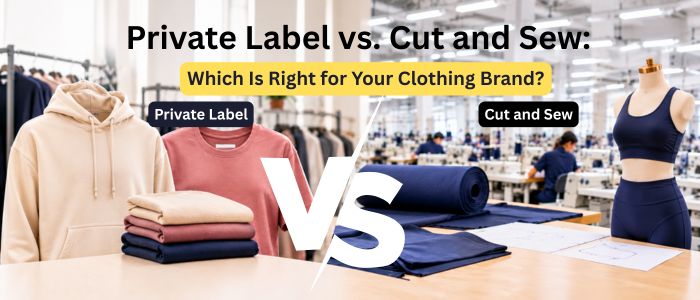
Most new clothing brands spend three weeks arguing about logo placement, then settle the biggest question in the business in about ten minutes.
Private label or cut and sew? That one choice sets your startup cost, your lead time, your minimum order, and how different your product looks next to everyone else on Instagram.
Two myths trip people up:
- The first is that private label means cheap and generic. It doesn’t, and plenty of brands doing serious revenue run on it.
- The second is that cut and sew belongs only to designers with deep pockets. Also wrong, though it asks a lot more of you up front.
What Is Private Label Clothing?
Private label clothing means the factory already makes the garment and you sell it under your own name. The pattern exists, the fit is proven, the fabric sits in stock.
You pick a style, choose colors and fabric weight, add your branding, and the product becomes yours.
A private label manufacturer keeps a library of in-house blocks: a 380 GSM fleece hoodie, a 240 GSM combed cotton tee, and a nylon windbreaker.
These have been sewn hundreds of times, so the line knows them cold and reject rates stay low.
What you can brand
Your artwork goes on through screen print, embroidery, puff print, silicone patches, or appliqué. You also get woven neck labels, printed tags, hang tags, care labels, polybags, and custom boxes.
Everything a customer touches carries your name. The garment is shared. The identity is not.
The workflow in short
You choose from a catalogue, pick colors and trims, approve a branded sample, then run bulk. No pattern making, no tech pack, no fit development from zero.
Those three steps are where most new brands lose their money and their patience, and private label skips all of them.
What Is Cut and Sew Manufacturing?
Cut and sew means the garment starts as your idea and gets built from flat fabric. Nothing exists yet. The factory cuts panels from your pattern and sews a piece that has never been made before.
You control the block, the fit, the fabric, the seams, and every trim.
The tech pack runs everything
A tech pack is the instruction manual for your garment: flat sketches, points of measure, grading rules, fabric and trim specs, stitch types, label placement, and packing notes. No tech pack, no cut and sew. A factory cannot guess what you see in your head, and the ones that try will send you something you hate.
Pattern making and fabric sourcing
A patternmaker turns your sketch into panels, then grades them across your size run. Get this wrong and every unit in your bulk order fits badly.
Fabric is its own project. You pick the fiber blend, weight in GSM, knit or weave structure, finish, and dye method. Some mills hold stock. Others want a minimum yardage before they knit anything for you, which pushes your MOQ up before a single garment is sewn.
Sampling takes rounds
A proto sample evaluates the idea, a fit sample goes on real bodies, then revisions follow. Two or three rounds are normal. The pre-production sample locks everything down and becomes the reference the QC team checks bulk against.
Private Label vs. Cut and Sew: Key Differences
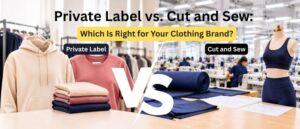
The split comes down to one question: are you renting a garment that already works, or building one from flat fabric? Private label trades control speed and a smaller bill. Cut and sew trades speed and money for a product that is completely yours.
| Feature | Private Label | Cut & Sew |
|---|---|---|
| Product Customization | Moderate | Full |
| Startup Cost | Lower | Higher |
| Development Time | Faster | Longer |
| MOQ | Lower | Medium to High |
| Branding | Private Label | Fully Custom |
| Tech Pack Required | Usually, No | Yes |
| Product Exclusivity | Limited | Complete |
| Fit Control | Factory Block | Your Block |
| Sampling Rounds | One | Two to Four |
| Ideal For | Fast Launch | Unique Collections |
The MOQ row matters most for a first-time brand, since a lower minimum lets you evaluate four styles instead of betting everything on one. The exclusivity row matters more as you grow. Once a competitor finds the same blank, your only defense is price, and price is a race nobody wins.
How Private Label Manufacturing Works
Six steps. Most brands go from first email to bulk shipment in four to eight weeks, depending on the branding method and how fast approvals come back.
- Pick your styles: Order a blank sample first so you can feel the fabric and check the fit on a real body.
- Choose fabrics and colors: A 280 GSM French terry reads summer; a 420 GSM brushed fleece reads premium winter. Same block, different product.
- Add your branding: Print or embroidery method, placement, and size, plus your woven label, neck tag, and hang tag set.
- Approve the branded sample: Check print registration, thread color, and label placement against your spec, then approve in writing with photos.
- Run bulk production: Inline checks catch problems while the line is still running, which beats finding them in a carton two months later.
- Packing and shipping: Polybags, folding, size stickers, carton marks. Tell the factory if goods go straight to a 3PL, since barcode rules change how cartons get packed.
Where you can still customize
Fabric weight, color, wash, trims, drawcords, zipper pullers, thread color, labels, and packaging are all your choices. What you cannot change is the pattern. Some factories allow small spec tweaks, like 2 cm more body length. Ask early because that answer shapes your whole range.
How to Cut and Sew Manufacturing Works
Nine steps. Plan for three to six months for a first style, with most of that time going into sampling and fabric rather than sewing.
- Concept development: Bring physical samples you like and mark what you want changed on each one. Factories read garments far better than adjectives.
- Tech pack creation: This document gets quoted, sampled, and inspected against, so vague entries cost real money later.
- Pattern making: Your block drafted and graded across sizes. Digital patterns make revisions much quicker than paper.
- Fabric sourcing: Test weight, shrinkage, pilling, colorfastness, and stretch recovery. Confirm mill minimums now because minimum yardage is the hidden number that blows up a budget.
- Prototype sampling: The first version will look rough. That is its job.
- Fit revisions: Mark changes in measurements, never in feelings. Asking for a slimmer sleeve gets you nothing. Asking to cut 1.5 cm off the sleeve opening gets you a fix.
- Pre-production sample: Correct fabric, trims, and labels. Sign it off and keep it. This sample settles arguments.
- Bulk production: Fabric inspection, marker making, cutting, sewing, finishing. Ask for a top-of-production sample from the first cartons.
- Inspection, packing, and shipping: AQL checks on measurements, stitching, print quality, and labels, then cartons and export papers.
Steps 4 to 7 are where timelines slip. Every fit round costs shipping days plus queue time at the factory, so give full feedback in one go instead of drip-feeding notes.
Cost Comparison
Private label costs less to start because you skip pattern making, fit development, and most of the sampling bill. Cut and sew costs more up front and less per unit later once volume climbs and you buy fabric directly instead of through a middle layer.
| Cost Area | Private Label | Cut & Sew |
|---|---|---|
| Product Development | Near Zero | Pattern, Grading, Tech Pack |
| Sampling | One Branded Sample | Proto, Fit Rounds, PP Sample |
| Fabric | Priced Into the Blank | Bought by the Roll, Mill MOQ Applies |
| Branding | Same for Both | Same for Both |
| Inventory Commitment | Smaller First Order | Larger First Order |
| Unit Cost at Volume | Flattens Out | Keeps Dropping |
What moves your price
Fabric is the biggest line in almost any garment, 40 to 60% of factory cost on a basic knit. Switch from regular cotton to combed ring-spun and your cost moves before anyone touches a machine.
Next comes labor minutes. A hoodie with a double-layer hood, kangaroo pocket, barracks, and cover stitched hems takes several times the machine time of a plain crew tee.
Then order quantity. Cutting, marker making, and screen setup get spread across your units, so 100 pieces carry a far heavier share of fixed costs than 1,000 pieces do.
Long-term profit
Private labels return cash faster because less money sits in development. Cut and sew gives you pricing power, since customers pay more for a fit, they cannot buy anywhere else.
Many brands run both: private label pays the bills, cut and sew builds the brand.
Which Option Offers More Customization?
Cut and sew, and it is not close. Private label customizes the surface of a garment. Cut and sew customizes the garment itself. Both give you full branding, but only one lets you change how the piece is built and how it sits on the body.
Fabric: Private label gives you a shortlist the factory stocks. Cut and sew opens the mills: blends, GSM, finishes, certifications, custom dyes.
Fit: Private label hands you the factory block. Cut and sew hands you the measuring tape, down to armhole depth, sleeve pitch, and grading rules.
Construction: Flatlock or overlock, taped seams, gussets, bound necklines, pocket bags, vents. These tell customers their product is better before they read a word of your copy.
Labels and packaging: Equal for both models. Woven labels, rubber patches, custom zipper pullers, boxes, tissue, and inserts are open to anyone.
Packaging and labels can be copied in a week. A fit your customers come back for cannot.
Which Manufacturing Model Is Better for Startups?
For the first brand with limited cash and no customer data, private label is the safer start. For a founder with a clear design point of view and funding behind them, cut and sew pays off faster than people expect.
Private labels get you to market in weeks instead of seasons. Lower minimums let you carry four or five styles and let customers show you which one sells, rather than dying on 500 units of the wrong thing.
The ceiling is real, though. You compete on marketing, not product, and margins shrink the moment someone finds your supplier.
Cut and sew makes the product the reason people buy, which changes your pricing, your press, and your retention. The risk is simple.
You can spend a year and your whole budget before learning whether anyone wants it. Brands die in sampling all the time.
What we see work: start private labels on two or three styles, sell them, then take the best seller into cut and sew with everything you learned about sizing and fabric baked into the tech pack.
Advantages of Private Label Manufacturing
Somebody else already paid for the hard part. The pattern, the fit testing, and the production bugs are behind you before you place your first order.
- Lower startup cost: No pattern fees, no grading, no mill minimums, one sample round instead of four.
- Faster to market: Weeks, not seasons, so a holiday window is still reachable.
- Simpler development: No tech pack, no fit sessions, no measurement spreadsheets.
- Cheap product testing: Low minimums let you launch several styles and drop the losers quietly.
- Lower production risk: The factory has built this garment hundreds of times.
- Quick reorders: Stock fabric and existing patterns bring a hot style back before the hype cools.
Advantages of Cut and Sew Manufacturing
Your garment belongs to you. Nobody can buy the same piece, swap the label, and undercut you next month.
- Original design: Your silhouette, your proportions, your pattern.
- Real difference: When the fit sells the product, marketing gets cheaper.
- Premium positioning: Retail buyers and press can spot a developed garment.
- Material control: You choose the mill, yarn, weight, finish, and certifications, which is the only way sustainability claims hold up.
- Better margins at volume: Fabric at mill price, and you pay only for the construction you chose.
- Brand assets: Blocks, graded size sets, and approved fabric specs make every future season faster to develop.
- Consistent sizing: A customer who wears medium in your tee wears medium in your jacket, so returns drop.
Common Mistakes When Choosing a Manufacturing Model
Most failed first production runs trace back to a handful of avoidable decisions.
Choosing on price alone: The cheapest quote hides something: lighter fabric than specified, cheaper trims, or no inspection before cartons close. You pay later in return and bad reviews.
Ignoring MOQ math: Mill minimums turn a 200-piece plan into a 600-piece commitment and eat the whole budget before you sell a unit.
Underestimating sampling: Two to four rounds are normal. Budget for one and you rush the approval, then find the fit problem across 800 finished pieces.
Skipping the tech pack: No spec means no reference and no claim when bulk comes out wrong. The factory built what the paperwork said, so if the paperwork said nothing, you owe the mistake.
Vague supplier communication: Approvals given on voice notes, feedback spread across three emails, nothing written down. Confirm every approval in writing with photos and measurements.
Unrealistic timelines: Knitting, dyeing, and finishing alone can run three to five weeks before cutting starts. Promise a launch date before the pre-production sample is approved, and you pay for air freight.
Weak branding plan: Paying for cut and sew on a product nobody can tell apart from a blank is money thrown away.
Every one of these lands is in the same place: your margin.
Which Manufacturing Option Is Best for Your Business?
Match the model to the job you need done this year, not the brand you want in five years.
| Brand Goal | Recommended Option |
|---|---|
| Launch Quickly | Private Label |
| Limited Budget | Private Label |
| Unique Product | Cut & Sew |
| Luxury Brand | Cut & Sew |
| Trend Testing | Private Label |
| Premium Fashion | Cut & Sew |
| Long-Term Brand Growth | Cut & Sew |
| Fast Ecommerce Launch | Private Label |
| Technical or Performance Wear | Cut & Sew |
| Merch for a Creator Audience | Private Label |
By business stage: Pre-launch with no customers: private label because you should buy information before inventory. Selling under a year: keep private label on basics and move your hero product to cut and sew. Established with repeat buyers: cut and sew across the range, since you already know your sizing and sell-through.
By budget: small budget: private label, with the savings going into photography and ads. Mid budget: a private label range plus one cut-and-sew signature piece. Funded or profitable: cut and sew with a patternmaker and proper fit sessions from day one.
By product strategy: If your design lives on the surface of the garment, private label gives you everything you need. If it lives in the garment itself, no amount of printing fixes the wrong block.
How Argus Apparel Helps Clothing Brands
We run private labels and cut-and-sew production under one roof, so your model stays a business decision rather than a limit set by your supplier.
Here are the problems brands bring us:
An idea but no drawings: We pull apart your references and build the product development brief and tech pack from there, so you end up with a document any factory could quote.
A tech pack you are unsure about: We review it before anything gets cut, catching missing points of measure, impossible seam combinations, and grading errors at the desk instead of on the sewing floor.
No luck finding the fabric: Our sourcing team works mills directly on weight, blend, finish, and certifications, then sends hangers so you can choose with the fabric in your hands.
A fit that is close but wrong: We run fit sessions and turn your feedback into measurement changes, then send a revised sample with a note on what changed and why.
A fast launch on a small budget: Private label branding on proven blocks with low minimums, so you can evaluate several styles at once.
Outgrowing blanks: Pattern making, grading, sampling, and bulk production happen in one place, so nothing gets lost between three vendors.
Inconsistent past orders: Fabric inspection, inline checks, and AQL inspection against the approved sample before cartons close, plus packing and labeling to your 3PL or retail rules across global markets.
Conclusion
Private label puts your brand on a garment that already works. Cut and sew builds a garment only your brand has. One buys speed and a smaller bill; the other buys a product nobody can copy by calling the same blank supplier.
On cost, private labels keep money out of development and in inventory and marketing. Cut and sew asks for pattern work, fabric minimums, and sample rounds first, then rewards you with better unit economics once volume arrives.
On customization, both give full branding, but only cut and sew gives you the fit, the fabric, and the construction.
Starting out? Launch private label, learn from real orders, then move your best seller into cut and sew. Already know your customer and your size. Go straight to cut and sew and build something worth defending.
Tell us what you are doing, your target price, and your launch date. We will tell you which model fits and how fast we can get you there.
Contact Argus Apparel with your sketches, references, or tech pack.
Frequently Asked Questions
What is the difference between private labels and cut-and-sew manufacturing?
Private labels put your branding on a garment the factory already produces. Cut and sew a garment from your own pattern and fabric. One changes the surface, the other changes the product.
Which is better for a startup clothing brand: private label or cut and sew?
Private label suits most startups: lower cost, faster launch, smaller minimums. Cut and sew suits founders with a funded budget and a product that must be different to sell.
Is private label clothing cheaper than cut and sewing?
Up front, yes, since you skip pattern making, grading, mill minimums, and extra sample rounds. At higher volume, cut and sew can win on unit cost.
Do I need a tech pack for private label manufacturing?
Not a full one. You need a branding sheet: logo files, print method, placement, size, labels, and packaging. Full tech packs belong to cut-and-sew.
What is the MOQ for private label clothing?
It varies by factory and style and sits well below cut-and-sew levels. Printed styles on stock fabric carry the lowest minimums, while custom dye colors push them up.
What is the MOQ for cut-and-sew manufacturing?
Higher, because the mill sets a minimum yardage before knitting or weaving your fabric. That number decides your MOQ more often than the sewing factory does.
Which option offers more product customization?
Cut and sew. You control pattern, fit, fabric, seams, trims, and grading. Private label limits you to style, color, stock fabrics, branding, and packaging.
Can I switch from private label to cut-and-sew later?
Yes, and many brands do. Bring your sales data, return reasons, and best-selling garment to the first meeting. That makes a far better tech pack than a mood board.
How long does each manufacturing process take?
Private label runs about four to eight weeks from approval to shipment. Cut and sew runs about three to six months for a first style, with faster repeats.
Which option has better profit margins?
Cut and sew over time, through pricing power and direct fabric buying. Private label early because less cash sits in development.
Is cut-and-sew better for premium clothing brands?
Yes. Premium pricing needs a reason, and fabric, fit, and construction are reasons customers can feel on the body.
Can Argus Apparel provide both private label and cut-and-sew manufacturing?
Yes, along with product development, tech pack review, pattern making, fabric sourcing, sampling, quality control, and packaging.
What factors should I consider before choosing a manufacturing model?
Budget, launch date, order quantity, how different your product needs to be, whether you have a tech pack, and how much fit control your customers care about.
How do I choose the right apparel manufacturer?
Check that they already make your category, ask for samples of current work, confirm MOQs per style and per color, and ask how they manage fit revisions and failed inspections.
What are the biggest mistakes clothing brands make when selecting a manufacturing partner?
Chasing the lowest quote, skipping the tech pack, ignoring mill minimums, approving samples verbally, and promising a launch date before the pre-production sample is signed off.