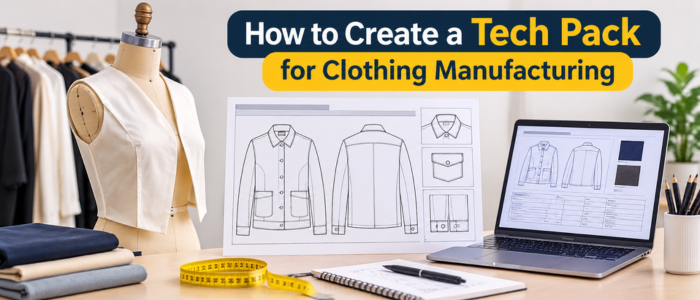
Most fit problems don’t start on the sewing floor. They start in the file the brand sent over.
A tech pack is that file. It tells a factory what to cut, what to sew it with, how big to make it, and how to pack it once it’s done. Send a good one and your first sample lands close.
Send a mood board and three phone photos, and you pay for the guessing: extra sample rounds, air freight to catch up on time, a hem sitting half an inch off across a whole size run.
This is where clothing brands quietly lose the most money in development. A missing stitch note becomes 3,000 hoodies with the wrong topstitch. A size chart with no tolerance column becomes a factory that measures nothing, because nobody told it what counts as a pass.
What follows is every page of a production-ready clothing tech pack, the order to build those pages in, what a factory reads first, and the mistakes that cost brands the most.
What Is a Tech Pack?
A tech pack is the technical document a clothing manufacturer uses to sample and produce one garment style.
It holds flat sketches, bill of materials, measurements, construction notes, branding placement, and packing rules for that style in a single file, which is why some brands call it a garment specification sheet or a spec pack.
Factories don’t design. They build. A cutting table and a sewing line read numbers and callouts, not intentions, and a pattern maker can’t guess whether you want a 1/4 inch single needle topstitch or a 1/2 inch double needle.
Think of it as the build drawing for your garment. An architect doesn’t hand a builder a watercolor of the house. They hand over dimensions, materials, and tolerances, and the same logic runs apparel production.
It’s also the document that settles arguments. When a shipment lands short on sleeve length, the tech pack decides who pays. Anything written in it is binding on the factory. Anything left out is the factory’s call.

Why Is a Tech Pack Important?
A tech pack matters because it removes guesswork from a process where guesswork costs real money. It cuts sample rounds, holds sizing steady across a size run, gives your factory enough detail to quote accurately, and lets you reorder the same garment next season without starting over.
Here’s what that looks like in practice.
- It stops costly mistakes before cutting: One brand we worked with wrote “ribbed cuff” with no width and no rib gauge. The factory sewed a 2-inch cuff. The brand wanted 3.5 inches. That’s a re-cut, not a fix.
- Sampling moves faster: A complete pack lets a sample room start the same week. An incomplete one sits in an inbox while someone asks questions by email across a six-hour time difference.
- Sizing stays consistent: Points of measure and grading rules keep a medium a medium, order after order. Online brands feel this immediately in return rates.
- Revisions drop: Four or five sample rounds on a basic tee is a documentation problem, not a factory problem. Two rounds are normal when the pack is clean.
- Costing gets honest: Your quote is built off fabric consumption, trim counts, and stitch time. Vague trims mean padded prices because factory prices are risky.
- Repeat orders get simple: A locked, versioned pack means your second run matches your first without a fit session.
Incomplete documentation shows up in predictable ways: a label sewn at the wrong center back, a zip in the right length but the wrong tape color, a polybag with no suffocation warning that a retailer rejects at the door. Each one lands at a different stage of the clothing manufacturing process, and the later it’s caught, the more it costs.
What Should a Clothing Tech Pack Include?
A factory-ready apparel tech pack runs to seven sections: product information, technical drawings, bill of materials, measurements, construction details, branding, and packaging. Miss any one of them and someone at the factory fills the gap for you.
Product Information
The cover page. Style name, style number, category, collection, season, sample size, intended fit, target cost, and date. Add a revision number and a short change log, because version drift causes more trouble than anything else on this list. If your factory must ask which file is current, you’ve already lost a day.
Technical Drawings
Flat, black, and white, proportional, drawn to the garment and not to the body. Front and back as a minimum. Add a side view on anything with a shaped panel and blow up details that need their own callout: pocket bag shape, placket, vent, drawcord exit, cuff finish.
Color the sketch only to show color blocking. Everything else stays line art so seam lines read clearly. Number your callouts and match those numbers to your construction page.
Bill of Materials (BOM)
Every material that goes into the garment, listed line by line with supplier, reference number, composition, color, placement, and consumption. Fabrics, linings, interlining, thread, zips, buttons, drawcords, elastic, labels, hang tags, polybag, carton.
List thread by Tex number and color code, not “black thread”. Give fabric weight in GSM, construction (jersey, French terry, twill), and finish. A BOM like this is what a sourcing team prices off, and it’s the page that decides your landed cost.
Measurements
A points-of-measure table for your sample size, a how-to-measure guide, a tolerance column, and grading rules across the full size run.
State your units. Centimeters or inches picked once and used everywhere. Say whether the garment is measured flat or on a form, since a flat chest measurement is half the body circumference and that single misunderstanding has ruined entire orders.
Tolerances run tighter on small points like a neck opening or cuff and wider on body widths, and anything measured outside tolerance counts as a defect.
Construction Details
Stitch type, stitch density per inch, seam class, seam allowance, finishing and reinforcement, written against the numbered callouts on your sketch.
Spell out bar tacks at pocket corners, twill tape at the shoulder seam, coverstitch at the hem, overlock on the side seams, and how the neck rib is set and closed.
Add interlining and fusing where it applies. This page is where garment durability is decided.
Branding
Neck label or heat transfer, size label, care and content label, woven side label, hang tag, and the artwork files for each. Give exact placement with measurements: center back neck, 1 cm below the seam, or 10 cm up from the hem on the side seam.
Include print and embroidery artwork at the finished size, with Pantone references and stitch counts. Care labels carry legal content and fiber rules that differ by market, so confirm the wording for wherever you’re selling.
Packaging Instructions
Folding method, tissue, polybag size and thickness, barcode type and placement, hang tag placement, inner carton counts, master carton size, size ratio per carton and carton markings.
Retailers reject shipments over packing errors that cost pennies to get right. If you sell on Amazon or to a department store, pull their packing manual and put those rules straight into this page.
Step-by-Step Guide to Creating a Tech Pack
Build the pack in this order. Each step feeds the next, and skipping ahead is what creates rework later.
- Define the garment concept: Write down the category, fit, target customer, price point, and the market you’re selling into. Pull two or three reference garments you own and note what you want copied and what you want changed.
- Create technical sketches: Draw front and back flats to proportion, then add detailed views. Number every callout now, before anything else references them.
- Specify fabrics and trims: Lock fabric weight, composition, construction, and finish. Order hand-feel swatches before you commit. Pick trims by supplier reference, not by description.
- Build the bill of materials: One row per material, with placement and consumption. Leave the cost column open if your factory is sourcing, and they’ll fill it during quoting.
- Add measurement specs: Start with your sample size, list every point of measure, add the how-to-measure notes, then set tolerances. Grade the rest of the run after the sample size is approved.
- Write construction instructions: Stitch types, seam allowances, stitches per inch, reinforcement points, and finishing, each tied to a sketch callout.
- Add branding details: Labels, tags, print, and embroidery artwork, with placement measured from a fixed reference point like the center back neck or the hem.
- Set packaging requirements: Fold, bag, tag, barcode, carton, and ratio.
- Review and finalize: Read it as if you’ve never seen the garment. Every number has a unit. Every callout has a matching note. Every material has a supplier. Then date it and give it a version number.
- Share it with your manufacturer: Send one PDF, not six loose files. Ask for a pre-sample review and let the factory flag anything unclear before cutting.
Keep a one-page tech pack checklist beside you while you build and tick each section off as it’s finished. We keep a copy of ours on the Argus Apparel product development page, and you’re welcome to work on it.
Tech Pack Example
A professional apparel tech pack runs six to twelve pages per style, one subject per page, numbered and dated. Here’s what a sample pack for a French terry hoodie looks like page by page.
Page 1, cover, and style summary: Style number AH-2411, category men’s hoodie, sample size M, season Autumn 2026, fit regular, revision 3 dated 12 August, with a change log line explaining what moved since revision 2.
Page 2, technical sketch: Front and back flats with sixteen numbered callouts, plus zoomed views of the kangaroo pocket opening, the hood seam, and the cuff.
Page 3, bill of materials: Rows for the 320 GSM cotton French terry, 1×1 rib for cuffs and hem, Tex 40 thread in two colors, drawcord with metal tips, woven neck label, care label, hang tag, polybag, and carton, each with a supplier reference and consumption figure.
Page 4, measurement chart: Points of measure down the left, sizes S to XXL across the top, a grade column, and a tolerance column. Chest, body length from HPS, sleeve length from center back, armhole, cuff height, hood height, pocket placement.
Page 5, construction: Callout 7, coverstitch hem at 1/2 inch. Callout 11, bar tack at both pocket openings. Callout 14, twill tape across the back neck. Seam allowances are stated for every seam type.
Page 6, label placement: Neck label centered, 1 cm below the neck seam. Care label on the inside left seam, 12 cm above the hem. Embroidery at 8 cm wide, placed 20 cm down from HPS.
Page 7, packaging: Flat fold with one tissue sheet, 300 gauge polybag, barcode on the lower right of the bag, 20 pieces per carton in a 2-4-6-4-2-2 ratio.
Tech Pack vs. Fashion Sketch
A fashion sketch sells an idea. A tech pack builds a garment. Both have a job, and brands get into trouble when they send the first and expect the second.
| Feature | Fashion Sketch | Tech Pack |
|---|---|---|
| Purpose | Design Concept | Production Guide |
| Measurements | No | Yes |
| Construction Details | Limited | Complete |
| Bill of Materials | No | Yes |
| Manufacturer Ready | No | Yes |
| Sampling Support | Limited | Full |
A croquis drawn on a stylized nine-head figure tells a factory nothing about proportion. A flat drawn to garment shape, with a 42 cm chest and a 1/2 inch coverstitch hem beside it, tells them everything.
Common Mistakes When Creating a Tech Pack
The same eight errors come up again, and each one has a price tag attached.
- Missing measurements: The factory measures the closest thing it has, which is its own block. Your garment comes back fitting someone else’s customer.
Cost: one full sample round, two to three weeks.
- Incomplete BOM: Trims left as “metal zip” or “nice button” get substituted with whatever is in stock.
Cost: either a sample you reject or a bulk order you’re stuck with.
- Low-quality sketches: Photos of a garment on a hanger, or a sketch too small to read seam lines. The sample room guesses at panel construction.
Cost: wrong seam placement, which is a pattern fix, not a sewing fix.
- No seam or stitch details: Single needle where you wanted double, 8 stitches per inch where you wanted 12. The garment looks cheap, and nobody did anything wrong.
Cost: your margin, every unit.
- Missing branding instructions: Labels sewn crooked or in the wrong position.
Cost: unpicking and resuming thousands of units, or a discounted order.
- Poor revision tracking: Three files named final, final2, and final-updated. The factory sews from the wrong one.
Cost: an entire production run.
- No packaging specs: Wrong carton counts and missing barcodes stop a shipment at a retailer’s dock.
Cost: chargebacks and a delayed launch.
- Incorrect grading: Jumping every measurement by the same amount across the run. Sleeve length and neck opening don’t grade like chest width.
Cost: an XXL that fits nobody and a return rate that eats your season.
Best Practices for Professional Tech Packs
Seven habits separate a pack a factory can run with from one that triggers a week of emails.
- Annotate, don’t describe: Draw a line to the seam and write the spec at the end of it. Paragraphs get skimmed. Callouts get read.
- Keep a revision history: One page at the front: version, date, what changed, who approved it. Your factory should never wonder which file is live.
- Use consistent terms: Pick “cover stitch” or “flatlock” and stay with it. Mixed terminology across pages reads as two different instructions.
- Put tolerances on every point of measure: Without them, a factory has no pass or fail line, and your QC team has nothing to inspect against.
- Supply high-resolution flats: Vector art, exported clean, big enough to read on a printed page in a sample room with bad lighting.
- Check your own numbers: Measure a reference garment flat and compare it to your chart before you send anything. Chest and body length errors are the two most common, by a distance.
- Walk the pack through with your factory before sampling: Thirty minutes on a call saves a sample round. Ask them what’s unclear and take the answer seriously, because they’ve sewn more garments than you have.
Software Used to Create Tech Packs
There’s no single right tool. Pick by how many styles you run a season and whether you need 3D fit.
| Software | Good For | Watch Out For |
|---|---|---|
| Adobe Illustrator | Flats, callouts, print-ready pages | Steep learning curve, no built-in spec tables, subscription cost |
| CLO 3D | Virtual fit, drape, fabric simulation | Needs pattern files to work properly, heavy hardware demands |
| Browzwear | 3D development at brand scale | Priced for teams, not for a first collection |
| Techpacker | Card-based packs, factory sharing, revision history | Less control over page layout than Illustrator |
| Excel or Google Sheets | Spec charts, BOM, grading maths | No drawing ability, so you still need flats from somewhere |
| PLM Software | Multi-style seasons, costing, approvals, version control | Setup time and license cost only pay off past 30 styles |
Most new brands run Illustrator for flats and a spreadsheet for specs, exported together as one PDF.
That combination is still what most factories receive, and it works perfectly well. Move to Techpacker or a PLM when version control starts costing you more time than drawing does.
If you don’t draw, hand a technical designer your reference garment and photos. A freelance tech pack for a simple style runs around $100 to $500, and $300 to $1,000 for something with multiple sizes and detailed construction.
Many manufacturers, Argus Apparel included, built the pack as part of product development instead.
How a Good Tech Pack Saves Money
Spending two days on documentation feels slow until you price the alternative. A clean pack pays back in seven places.
- Fewer sample rounds: Each round costs sample charges plus two-way courier plus two to three weeks. Cutting four rounds to two is real money and a month of calendar.
- Faster approvals: Clear specs mean a fit comment takes a line instead of a call.
- Better costing: Factories’ quote risk. Give them exact consumption and trim references, and the padding comes out of your unit price.
- Less waste: Correct consumption figures and marker-friendly specs mean less fabric bought and less left on the cutting room floor.
- Fewer mixed messages: One file replaces a WhatsApp thread, and nobody sews from a message they half remember.
- Stronger QC: Inspectors need a number to measure against. Tolerances give them one, so defects get caught in the factory rather than by your customers.
- Easy repeat orders: A locked pack means your reorder matches last season without a new fit session.
A brand running ten styles a season that saves two sample rounds per style is saving twenty rounds of sampling, shipping, and waiting. That’s a season’s worth of time back.
How Argus Apparel Helps Brands Create Production-Ready Tech Packs
Most brands who come to us arrive with a half-finished file, or with no file and a garment they love. We start where you are.
- Challenge: you have a design idea but no technical drawings.
We run a design consultation, then draw the flats, callouts, and detail views from your references and fit notes.
- Challenge: you have a tech pack, but samples keep coming back wrong.
We review the pack line by line before anything is cut and tell you exactly which pages a factory can’t work from. Nine times out of ten, the problem sits in the measurement or construction pages.
- Challenge: you don’t know which fabric to specify.
Our sourcing team sends hand-feel swatches against your target weight, hand, and price, then writes the confirmed fabric straight into your BOM.
- Challenge: your fit is right in a medium but wrong at the end of the run.
We manage pattern making and size grading in-house, so grade rules are built off your pattern rather than from a generic chart.
- Challenge: you need to go from sample to bulk without surprises.
Sampling, fit approval, production planning, in-line, and final quality checks, and cut-and-sew manufacturing all run under one roof, against the same document.
You keep the tech pack. It’s yours, and it stays usable with any factory you work with later.
Conclusion
Every clothing brand needs a tech pack, whether you’re making 50 pieces with a local tailor or 5,000 with an offshore factory. It’s the one document that turns a design into something a sewing line can repeat.
Get seven things on paper: product information, flats, BOM, measurements with tolerances and grading, construction, branding, and packaging.
Avoid the mistakes that cause the most damage, which are missing measurements, vague trims, and untracked revisions. Then review the pack with your manufacturer before anything gets cut.
If you’d rather not build it alone, that’s what we do as a custom apparel manufacturer.
Send Argus Apparel your sketches, your reference garment, or whatever you have so far, and we’ll tell you what’s missing and quote the development work to finish it.
Get in touch, and we’ll look at your style this week.
Frequently Asked Questions
How do I create a tech pack for clothing manufacturing?
Start with your garment concept, draw numbered flat sketches, list every material in a BOM, build a points of measure chart with tolerance and grading, write construction notes against your callouts, add branding and packaging, then review it with your factory before sampling.
What should be included in a clothing tech pack?
Product information, technical drawings, bill of materials, measurements with tolerances and grading, construction details, branding and label placement, and packaging instructions.
Can I create a tech pack without design software?
Yes. A clear hand-drawn flat, photographed, and annotated, plus a measurement chart and BOM in a spreadsheet, works for a simple style. Factories care about clarity, not software.
What is a Bill of Materials (BOM) in a tech pack?
A line-by-line list of every material in the garment with supplier, reference, composition, color, placement, and consumption. It’s the page your costing is built from.
What are Points of Measure (POM)?
The specific places on a garment are measured, like chest width or body length from the high point of the shoulder, each with a target number, a tolerance, and a grade rule across sizes.
Why do manufacturers require a tech pack?
Because they build specs. Without one, a factory substitutes its own blocks, trims, and construction, and the result is whatever its house standard happens to be.
How much does it cost to create a professional tech pack?
Freelance rates run $100 to $500 for a simple style and $300 to $1,000 for complex garments with full size runs. Many manufacturers build it as part of development instead.
What software is best for creating apparel tech packs?
Adobe Illustrator for flats paired with Excel for specs covers most new brands. Techpacker suits brands wanting version control, and CLO 3D or Brow wear suit teams doing virtual fit.
Can a manufacturer help me create a tech pack?
Yes. Argus Apparel builds packs from sketches, reference garments, or a rough brief, and reviews existing packs before sampling starts.
How long does it take to prepare a tech pack?
Two to five working days for a simple style once fabrics are chosen. Complex outerwear with many trims takes one to two weeks.
What are the most common tech pack mistakes?
Missing measurements, vague trim descriptions, no stitch or seam specs, untracked revisions, no tolerances, and wrong grade rules.
Can I update a tech pack after sampling?
You should. Fit comments from the first sample go back into the pack as a new, dated revision before the second sample is made.
Do private label clothing brands need a tech pack?
Yes, even for blanks you’re only customizing. Label placement, print artwork, packing, and measurement checks all need written down.
How does a tech pack improves production quality?
It gives QC something to inspect against. Tolerances turn a vague look right into a pass or fail an inspector can apply on the line.
Can Argus Apparel help create a production-ready tech pack?
Yes. We manage technical drawings, BOM, pattern making, grading, sampling, and bulk production, so the same team that writes the pack is the one that sews from it.