Two sweaters can look identical on a hanger and cost quite different amounts to produce. The reason is inside the garment.
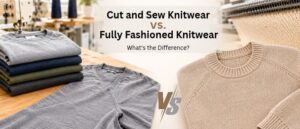
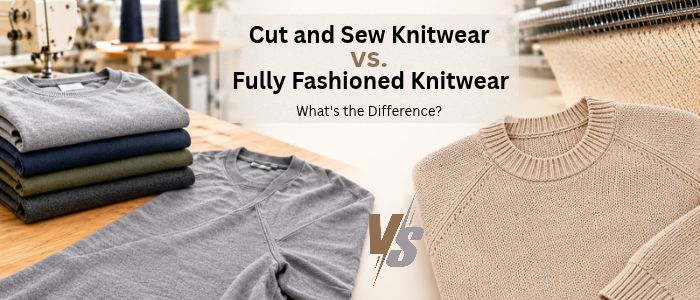
Knitwear gets built two ways. You knit fabric in rolls, cut shapes from it, and stitch them together. Or you knit each panel to shape and link them. The first is cut-and-sew knitwear. The second is fully fashioned.
That choice drives your cost per unit, how the shoulder sits, how much yarn hits the scrap bin, and how long you wait for bulk.
What Is Cut and Sew Knitwear?
Cut and sew knitwear is made from knitted fabric that gets produced in rolls first, then cut into pattern pieces and stitched together on sewing machines. The knitting and the shaping are two separate jobs.
A circular or flat knitting machine makes a large run of fabric. French terry, jersey, interlock, rib, fleece, loop back, whatever the product calls for. That fabric goes through inspection, relaxing, and sometimes washing before anyone touches it with a cutter.
Then it works like any woven garment. A marker gets laid out, fabric is spread in plies, a cutting machine follows the pattern, and the pieces move to a sewing line. Overlock machines close the seams. Flatlock, cover stitch, and barrack machines finish the details.
What usually gets made this way
- Hoodies and crewneck sweatshirts
- T-shirts and long-sleeved tees
- Knit dresses and skirts
- Joggers, shorts, and tracksuits
- Casual knit tops and loungewear
- Polo shirts in jersey or piqué
Why brands choose it
Cutting and sewing gives you room to move. Want the body two centimeters longer? Change the pattern. Want a different neckline on the same fabric? Change the pattern. You’re not reprogramming a knitting machine; you’re redrawing a shape.
Cost sits lower per unit at volume. Sewing lines run fast, operators are trained in specific operations, and output climbs quickly once a style settles in.
Fabric choice opens wide. You can buy or develop almost any knit construction, blend, weight, or finish, including fabrics that fully fashioned machines simply can’t produce.
Lead times come in shorter. Fabric can be knitted while patterns are being finalized, and sewing capacity is far easier to find than fine gauge knitting capacity.
What Is Fully Fashioned Knitwear?
Fully fashioned knitwear is knitted panel by panel into the finished shape of each garment part. The machine adds and drops stitches to create armholes, shoulder slopes, neck curves, and sleeve tapers, so almost nothing gets cut away.
Those panels get joined by linking, not sewing. A linking machine catches each loop at the panel edge and marries it to the matching loop on the next panel, stitch for stitch. The join stays flat and flexible instead of forming a bulky cut-and-overlocked seam.
Look at the front of a good fully fashioned sweater near the armhole, and you’ll see small marks running up the edge. Those are fashion marks; the visible evidence of stitches being moved to shape the panel. Knitwear buyers read them the way a tailoring buyer reads a hand-padded lapel.
What usually gets made this way
- Crewneck and V-neck sweaters
- Cardigans with button or zip fronts
- Pullovers in merino, cashmere, lambswool, and cotton
- Knit polos and knitted shirts
- Fine gauge dresses and knitted sets
- Luxury knitwear for designer collections
Why brands choose it
The fit lands closer to intention. A shoulder knitted to the right slope sits on the body instead of being forced there by a seam.
Yarn waste drops hard. You’re knitting the shape, so there’s barely an offcut to throw away. For a brand buying cashmere at serious money per kilo, that difference shows up straight on the cost sheet.
The garment reads as premium because it is built like premium. Flat linked seams, clean edges, and shaping that follows the body are the details a customer feels before they can explain.
Movement improves. Linked seams stretch with the knit instead of fighting it, so the garment moves with the wearer rather than pulling at the armhole.
Cut and Sew Knitwear vs. Fully Fashioned Knitwear (Quick Comparison)
| Feature | Cut & Sew Knitwear | Fully Fashioned Knitwear |
|---|---|---|
| Manufacturing Method | Knit fabric is cut into pattern pieces and stitched together. | Panels are knitted to shape and linked together. |
| Material Waste | Higher due to cutting offcuts. | Lower because panels are shaped during knitting. |
| Production Cost | Generally lower. | Generally higher. |
| Fit | Standard, pattern-driven fit. | More precise shaping based on garment construction. |
| Scalability | Excellent for larger production runs. | Moderate, depending on machine capacity and design complexity. |
| Lead Time | Generally faster. | Generally longer due to shaping and linking requirements. |
| Premium Appeal | Medium, depending on fabric and finishing. | High, especially for refined, shaped knitwear. |
| Best For | Everyday apparel and cost-conscious collections. | Luxury knitwear and premium collections. |
How Cut and Sew Knitwear Is Manufactured
Cut and sew runs as a nine-step flow, and most of the risk sits in the first three steps rather than the sewing room.
- Yarn selection: Fiber blend, count, twist, and color are locked. This decides hand feel, pilling behavior, and shrinkage long before anyone sees a garment.
- Fabric knitting: Circular machines produce tubular or open-width fabric. Flat machines manage ribs, collars, and cuffs.
- Fabric inspection: Rolls get checked on a light table for needle lines, holes, barre, and shade variation between dye lots. Catching a fabric fault here costs pennies. Catching it after cutting costs the whole order.
- Pattern making: Patterns get built with shrinkage allowance already included, since knits move during washing. A pattern that ignores shrinkage produces a perfect sample and a short bulk.
- Fabric relaxing and spreading: Fabric rests flat for several hours to release tension from knitting and rolling. Skip this and panels shrink unevenly after cutting.
- Cutting: Fabric is spread in plies and cut to the marker. Marker efficiency decides your true fabric consumption, and a few percentage points here move your cost per unit noticeably.
- Sewing: Panels move along a line of specialized machines. Each operator manages one operation, which is exactly why this method scales.
- Washing and finishing: Garment wash, softening, pressing, and steaming settle the fabric and fix the final measurements.
- Quality inspection: Measurement checks against the spec, seam strength, stitch density, and shade grouping.
What does this mean for your order
Fabric utilization typically lands between 75 and 85% depending on the style and the marker. The rest is offcut. Bigger orders improve this because markers can be nested more efficiently across sizes.
Efficiency climbs with repetition. A line making the same hoodie for three weeks gets faster every week, which is why cut and sew pricing improves so sharply with volume.
Capacity is rarely the bottleneck. Sewing lines exist everywhere, so you can grow a cut and sew program without hitting a wall.
How Fully Fashioned Knitwear Is Manufactured
Fully fashioned runs as a seven-step flow, and the heaviest work happens before a single panel exists.
- Yarn selection: Fine gauge work needs consistent, evenly spun yarn. Weak or uneven yarn snaps mid-knit and stops the machine, which is why yarn quality matters more here than in cut and sew.
- Machine programming: A technician writes the knitting program that tells the machine when to add stitches, drop them, transfer them, and change structure. This is skilled work, and it takes time, which is the main reason sampling runs longer.
- Knitting the panels: Front, back, sleeves, collar, and plackets each come off the machine already shaped. A fine gauge sweater panel can take 20 to 40 minutes of machine time, and machine time is the real cost driver here.
- Panel inspection and mending: Each panel gets checked for dropped stitches and yarn faults. Small faults get mended by hand before linking.
- Linking: Panels get joined loop to loop on a linking machine. An experienced linker is genuinely hard to replace, and linking quality is the single clearest marker between good and mediocre fully fashioned knitwear.
- Washing and finishing: Washing relaxes the yarn and brings out the hand feel the buyer approved. Steaming and pressing set the final shape and measurements.
- Quality inspection: Panel alignment, linking consistency, measurement accuracy, and surface appearance all get checked.
What does this mean for your order
Precision comes from the program, not the pattern. Once a program is right, every garment knits to the same shape, which keeps size consistently tight across a bulk run.
Yarn waste often sits under 5%. For expensive fibers, saving can offset a meaningful slice of the higher labor cost.
Capacity is the real constraint. Fine gauge machines and skilled linkers are limited, and good factories book out months ahead for autumn and winter deliveries. Plan your calendar around that, not against it.
Advantages of Cut and Sew Knitwear
Cut and sew is the right call when your priority is unit economics, speed, and volume rather than a premium knit story.
Lower manufacturing cost: Fabric gets knitted in long, efficient runs, and sewing is faster per garment than knitting panels and linking them.
Faster production: You can knit fabric while patterns and trims are still being sorted, which compresses the whole calendar.
Easier pattern changes: A fit comment turns into a pattern edit, not a machine reprogram. Second samples come back in days.
Built for high volume: A line producing 1,500 hoodies a day holds that pace. Fully fashioned simply can’t match that output on the same floor space.
Wider fabric choice: Brushed fleece, French terry, loop back jersey, interlock, waffle, and dozens of blends. Most of these can’t be produced on a fully fashioned machine at all.
Right for casual and sportswear: Performance fabrics with elastane, moisture management finishes, and bonded constructions all live in the cut-and-sew world.
Trim and detail freedom: Pockets, zips, paneled colorless, piping, and printing all sit naturally in a sewing operation.
Advantages of Fully Fashioned Knitwear
Fully fashioned earns its cost when fit, finish, and material efficiency matter more than speed.
- Better fit through the shoulder and armhole
The shape is knitted in, so the garment sits on the body instead of being folded into place.
- Cleaner appearance
No cut edges, no bulky overlocked seams inside, nothing scratching the wearer’s underarm.
- Less yarn waste
Shaping at the machine means almost no offcuts, which matters most on cashmere, merino, and other premium fibers.
- Better drape
The knit keeps its natural weight and movement because it hasn’t been cut and stitched into a fixed shape.
- More comfort
Flat linked seams don’t press into the skin the way a stitched seam can, especially around the neck and shoulders.
- Clear premium positioning
Fashion marks and flat seams are recognized quality signals. Buyers at better retailers look for them.
- Longer wearing life
Cutting edges in knit fabric wants to unravel over time. Linked seams don’t have that weakness, which is one reason good fully fashioned knitwear survives years of washing.
What Each Option Costs
Fully fashioned cost more per unit in every scenario, mainly because of machine time and skilled labor. The gap can range from modest to more than double depending on gauge, yarn, and complexity.
- Yarn quality and price
Cashmere, extra fine merino, and silk blends shift the cost base more than the construction method does. On expensive yarn, the lower waste in fully fashioned pulls some of that cost back.
- Machine programming
Each fully fashioned style needs its own program, written by a technician. This is a fixed development cost, so it hurts small orders and almost disappears from large ones.
- Machine time per panel
Finer gauge means more stitches and more minutes on the machine. A 14 gauge sweater costs noticeably more in machine time than a 7 gauge one.
- Labor
Cut and sew uses line operators, each doing one task at speed. Fully fashioned uses linkers and menders whose work can’t be broken down the same way.
- Sampling
Expect more development rounds on fully fashioned. Programming adjustments take longer than pattern adjustments.
- Order volume
Cut and sew pricing improves faster with volume. Fully fashioned improves too, but machine time per garment stays fixed no matter how many you order.
- Finishing
Hand mending, careful pressing, special washes, and hand-set buttons all add cost, and fully fashioned programs tend to carry more of these.
A practical way to read this: work out your fully fashioned cost across a realistic order, not a minimum one. Programming spread over 300 pieces looks painful. Spreading over 2,000, it stops being the issue.
What Each Option Costs the Planet
Fully fashioned is the lower waste method at the garment level because shaping happens at the knitting machine instead of the cutting table.
- Material waste
Cut and sew lose 15 to 25% of fabric as offcuts, depending on the style and marker efficiency. Fully fashioned people usually lose under 5%. That’s the clearest environmental difference between the two.
- Energy use
Fully fashioned machines run longer per garment, so energy per piece can be higher even while material waste is lower. Neither method wins cleanly here.
- Material efficiency
Knitting to shape uses yarn only where the garment needs it. Cutting from a roll always sacrifices the spaces between pattern pieces.
- Production waste
Cut and sew generates fabric scrap that’s awkward to recycle because of blends and finishes. Fully fashioned generates mostly yarn waste from setup and mending, which is cleaner and easier to reuse.
- Garment lifespan
This is the part most sustainability conversations skip. A sweater worn for six years beats a sweater worn for one, whatever the production waste figures say. Fully fashioned garments usually last longer because their seams don’t fail the same way.
Cut and sew isn’t automatically the worse choice. A well-cut program with efficient markers, recycled yarn, and offcut recovery can land in a decent place. The construction method matters less than what the factory does with its waste and how long the garment survives.
Which Manufacturing Method Is Best for Your Brand?
Match the method to your price position and order profile, not to what sounds more impressive in a product description.
| Brand Type | Recommended Method |
|---|---|
| Luxury Fashion | Fully Fashioned |
| Premium Knitwear | Fully Fashioned |
| Designer Collections | Fully Fashioned |
| Streetwear | Cut & Sew |
| Sportswear | Cut & Sew |
| Promotional Apparel | Cut & Sew |
| Corporate Apparel | Cut & Sew |
| Large Retail Programs | Cut & Sew |
How to apply this
If your retail price sits under three times your cut and sew cost, fully fashioned will squeeze your margin uncomfortably. Make the numbers work before falling in love with the construction.
If your customer inspects garments before buying, fully fashion pays you back. Someone spending $200 on a sweater turns it inside out. Someone buying a $70 hoodie doesn’t.
If you’re building a sportswear or streetwear range, cut and sew isn’t the compromise; it’s the correct method. Performance fabrics and graphic-led designs belong there.
If you’re launching a first collection with modest quantities, start cutting and sewing for your volume styles and run two or three fully fashioned hero pieces. That mix gives you a premium anchor without betting the whole budget on it.
If you’re supplying a large retail program, cut and sew keeps delivery dates realistic. Fully fashioned capacity gets booked out, and missing a retailer’s window costs more than any construction upgrade earns.
Common Mistakes Brands Make
Choosing on price alone
A sweater quoted 40% cheaper might be knitted on coarser gauge machines with lower twist yarn. It’ll pill after four washes, and your returns will swallow the savings. Compare like with like: same gauge, same yarn count, same finishing.
Ignoring where the product sells
Fully fashioned cashmere sold through a marketplace that discounts 50% twice a year is a cost you’ll never recover. Match construction to channel, not just to ambition.
Picking yarn by price instead of behavior
Yarn drives hand feel, pilling, shrinkage, and recovery more than construction does. Ask for twist level, fiber length, and a pilling test result. Cheap yarn in a fully fashioned garment still makes a disappointing sweater.
Skipping proper sample rounds
Brands approve a sample in one color, then get bulk in five colors and find two of them feel different. Different dye lots and dyestuffs change hand feel. Approve a strike-off per colorway and a washed sample, not just a first fit.
Underestimating fully fashioned timelines
Programming takes real days. Fine gauge knitting takes real machine hours. A brand that books fully fashioned on a cut-and-sew calendar misses its delivery, then airfreights, and loses everything the better construction was supposed to gain.
Choosing the wrong knitting gauge
Gauge decides weight, drape, and price. A 3 gauge chunky knit and a 14 gauge fine knit are entirely different products. Brands often pick gauge based on a reference image without checking whether it suits their season, price, or target market.
Treating quality inspection as a final step
Fabric inspection before cutting, panel inspection before linking, in-line checks during production. By the time a finished garment fails final inspection, you’ve already paid for it.
How Argus Apparel Supports Knitwear Brands
- Challenge: You don’t know which construction your product should use
We review your design, target price, and sales channel before quoting anything, then recommend the method that fits your numbers. Sometimes the answer is a mix across your range, and we’ll say so.
- Challenge: Your yarn isn’t performing the way you expected
Our yarn sourcing covers cotton, merino, cashmere, lambswool, acrylic blends, and recycled fibers. We supply hand feel references and pilling results, so you choose with data instead of a photo.
- Challenge: Your tech pack has gapped the factory keeps asking about
We review tech packs before sampling and flag missing measurements, unclear trims, and construction details that won’t work in production. Fixing this on paper saves a sample round.
- Challenge: Sampling keeps dragging on
Our pattern making and knitwear development teams manage fit comments quickly, with clear explanations of what changed and why. You get fewer rounds, not more.
- Challenge: You need both casual and premium knitwear from one partner
We run cut and sew production and support fully fashioned knitwear, so your hoodies and your hero sweaters come from the same managed process with the same quality standard.
- Challenge: Bulk quality drifts away from your approved sample
Our quality control runs through fabric inspection, in-line checks, and final AQL inspection. Measurements get checked against your approved spec, not against a vague idea of close enough.
- Challenge: You’re launching a private label range and need the whole process managed
Our private label clothing manufacturing covers development through bulk production and packaging, with your branding, labelling, and packaging built in from the start.
Trends in Knitwear Manufacturing
- Sustainable yarns are now standard requests, not special ones
Organic cotton, recycled wool, recycled polyester, and responsibly sourced merino show up in most briefs we receive. Certification documents matter to retailers, so ask for them early.
- Recycled fibers have improved
Recycled cotton and wool blends used to mean a rough hand feel. Current blends manage much closer to virgin fiber, which has opened them up to premium ranges.
- 3D and whole garment knitting is growing
These machines knit a complete garment in one piece with no linking at all. Machine cost and programming skills keep it limited to specific products, but it’s expanding steadily, especially in performance knitwear.
- Premium knitwear demand keeps rising
Shoppers buying fewer, better pieces have pushed sweaters and cardigans up in importance across many brands’ ranges.
- Smart manufacturing is reaching knitting floors
Digital production tracking, machine monitoring, and better planning systems shorten lead times and catch problems earlier.
- Luxury private labels are expanding
More brands want fully fashioned quality under their own label without running a factory, which has pushed manufacturers to develop deeper knitwear capability.
- Low waste production is becoming a buying requirement
Retailers increasingly ask about fabric utilization and waste handling during supplier approval, not after.
Conclusion
It comes down to one thing: cut and sew shapes fabric after knitting; fully fashioned shapes it during knitting.
Cutting and sew costs less, moves faster, and scales further. Fully fashioned fits better, wastes less yarn, and reads as premium.
Most brands don’t need to pick one for everything. Use cut and sew for volume styles, fully fashioned where your customer will notice.
The bigger decision is your manufacturer. A factory that only owns sewing lines will quote you cut and sew whatever your product needs.
Send us your designs, target price, and timeline, and we’ll tell you which construction makes sense. Contact Argus Apparel to start your knitwear development.
FAQs
What is the difference between cut and sews knitwear and fully fashioned knitwear?
Cut and sew knitwear is made by knitting fabric in rolls, cutting pattern pieces from it, and sewing them together. Fully fashioned knitting panel by panel into the finished shape and joined by linking. Cut and sew costs less and produces faster. Fully fashioned fits better and wastes less yarn.
What is cut and sew knitwear?
Knitted fabric produced in rolls, then cut into pattern and stitched on sewing machines. It covers hoodies, sweatshirts, T-shirts, knit dresses, joggers, and most casual knitwear.
What is fully fashioned knitwear?
Knitwear where each panel is knitted to its exact shape by adding and dropping stitches, then joined loop to loop by linking rather than cutting and sewing. Sweaters, cardigans, and knit polos are common products.
Fully fashioned. Shaped panels, flat linked seams, and visible fashion marks are recognized quality signals in better retail.
Is fully fashioned knitwear more expensive?
Yes, in all cases. Machine programming, longer knitting time per panel, and skilled linking all add cost. The gap narrows on large orders and on expensive yarns where the lower waste helps.
Which method creates less fabric waste?
Fully fashioned. It typically wastes under 5% of yarn, while cut and sew loses 15 to 25% as cutting offcuts.
Which manufacturing process is better for bulk production?
Cut and sew. Sewing lines produce far more units per day than knitting and linking, and sewing capacity is much easier to secure at scale.
What products are best suited for fully fashioned knitwear?
Sweaters, cardigans, pullovers, knit polos, fine gauge dresses, and luxury knitwear where fit and finish justify the cost.
Is cut and sew knitwear more durable?
Usually not. Cut edges in knit fabric are a weak point over repeated washing, while linked seams stay stable. Good cut and sew with proper seam finishing still lasts well but fully fashioned holds up longer.
Which method is better for luxury fashion brands?
Fully fashioned, for anything a customer will examine closely. Luxury brands still use cut and sew for casual and performance pieces within the same range.
Can Argus Apparel manufacture both cut and sew and fully fashioned knitwear?
Yes. We manage cut and sew production in-house and support fully fashioned knitwear, along with development, yarn sourcing, pattern making, sampling, and quality control for both.
How do I choose the right knitwear manufacturing process for my brand?
Start with your retail price and your customer. If your margin supports it and your customer inspects garments before buying, full fashion is worth it. If you’re competing on price, selling at volume, or working with performance fabrics, cut and sew is the right method. Send your designs to a manufacturer who builds both and ask for a cost comparison.