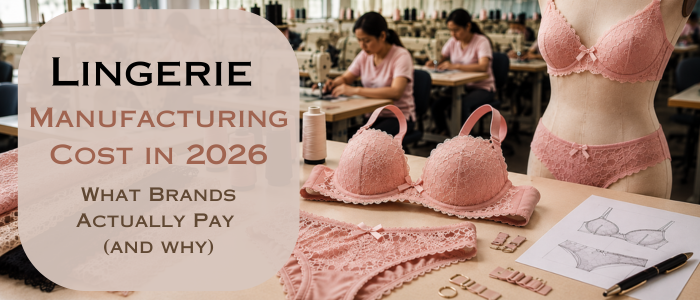
Most founders walk into lingerie thinking it will cost what a t-shirt costs. Then the first quote lands and reality kicks in. Pieces are tiny. Margins look juicy on paper. But the construction, the materials, the millimetre-level fit work? That is where the lingerie manufacturing cost quietly stops behaving like other apparel. Ask any honest lingerie manufacturer and you will hear the same thing: lace, elastics, cup builds, three-stage sampling. None of it scales like cotton tees. And 2026 has not made it cheaper.
The Five Levers That Move Your Price Tag
No single number works because pricing bends around five things. Watch any sourcing manager and you will see them juggle the same list.
- Fabric type and quality
- Design complexity (a soft bralette versus a four-panel underwire)
- Trims, closures, accessories
- Labor skill and production knowledge
- Order quantity, your MOQ
They are tangled. Touch one, the others shift. Go fancier on lace, your lingerie production cost jumps everywhere. Cut your MOQ for a small test launch, your lingerie cost per unit balloons because setup costs do not shrink just because your order does.
Fabric: Where Most of Your Budget Lives
Fabric eats more of your build cost than anything else. Most lingerie textiles are specialty stuff, and specialty stuff is not cheap.
- Lace, particularly Leavers or European narrow lace, top of the range
- Satin and silk, mostly for luxury sleep and bridal
- Mesh and tulle when you want sheer and breathable
- Cotton blends for everyday wear
- Spandex and elastane blends for stretch and recovery
It not just looks. Recovery, hand-feel, durability through ten wash cycles. That is what decides if your customer comes back. And that is really where the intimate apparel manufacturing cost conversation starts pulling its weight.
Trims and the Quiet Cost Multipliers
People shrug at trims. Big mistake.
- Elastic bands, straps, picot edging
- Hooks, eyes, sliders, rings (metal looks pricier than it costs)
- Padding, melded cups, underwires
- Lace appliqué, bows, embroidery, the occasional rhinestone
Each one has its own supplier, its own MOQ, its own lead time. Stack four or five upgrades on a single bra and you have added real money to the bra and underwear manufacturing cost before a single needle drops.

Skilled Hands, Premium Pay
Slippery fabric. Tiny panels. Tolerances in millimetres. Lingerie needs operators who can sew bras cleanly, and that pool is smaller and better paid than the one cutting basic tees. QC matters more here, too. Fit complaints kill intimates’ brands faster than anything else. That skill premium shows up at every stop of the custom apparel manufacturing process, from cutting room to puckout.
Branding That Earns Its Keep
Customization is not a flex in this category. It is the baseline.
- Custom lace patterns or exclusive prints
- Embroidered logos, jacquard waistbands, woven labels
- Branded hangtags, care labels
- Pouches, rigid gift boxes, retail-ready packaging
These things lift perceived value. They also chew through development time and tooling money. Founders building custom lingerie cost estimates should price branding into the model up front. Tacking it on later always hurts more.
Also Read: How Much Is the Cost of a Custom Bra in 2026? A Complete Pricing Breakdown
Why Your Order Size Changes Everything
MOQs bite harder here because every style multiplies across sizes and usually colours. Take a 300-unit run, five sizes, two colourways. You are left holding thirty of each variant. Which is why getting your head around MOQ in clothing manufacturing is not optional before you sign anything. Bigger runs drop your unit price. Smaller runs let you evaluate the market without setting cash on fire. The trade-off is the whole game.
The Costs Nobody Warns First-Time Founders About
The unglamorous line items are where budgets leak.
- Tech pack development and grading
- Sampling rounds (three to five is normal for bras)
- Fit testing across the size run
- Packaging, polybags, hangtags
- Freight, duties, last mile
Sampling runs higher in intimates than anywhere else. The custom bra cost breakdown is a useful reference if you want a feel for the numbers, since bras carry the heaviest sampling load in the category.
2026 Price Ranges briefly
Quoting exact dollar figures is a fast way to be wrong. But the broad bands look something like this for brands producing in or sourcing through the US.
| Tier | Design Profile | Per-Unit Range |
|---|---|---|
| Basic, low MOQ | Cotton bralettes, simple panties | Higher per piece, low scale |
| Mid-range | Mesh, lace trim, structured cups | Moderate, scalable |
| Premium | Leavers lace, silk, multi-panel bras | Highest, complex builds |
Those bands reflect the larger lingerie manufacturing cost picture in 2026: raw materials are pricier, ethical sourcing carries a real premium, and US labour rates have crept up another notch.
Other things tugging at budgets right now. OEKO-TEX certified materials are becoming table stakes. Inclusive sizing is doubling or tripling grading work. Retail-grade packaging is no longer optional for DTC brands trying to feel premium. Anyone partnered with a serious lingerie manufacturer this year should expect those costs to show up. Not disappear.
Trimming Cost Without Trimming Quality
You can keep the lingerie production cost in check without wrecking the product. Cleanly.
- Start with two or three hero styles, not a sprawling collection
- Use stock trims and standard cup Molds on the first run
- Cap colour and size variants until you have sales data
- Plan MOQs around an honest six-month sell-through, not dreaming
- Work with a partner who manages private label manufacturing end-to-end, so you scale under one roof
What you should not cheap out on: elastics, cup foam, finishing. Those are what survive (or do not survive) the wash. Intimates’ customers do not give second chances.
How Argus Apparel Fits into Your Lingerie Plans
Argus Apparel sits with intimates’ brands through every step, sketch to retail-ready cartons. The team manages delicate fabric work, fit-driven sampling, flexible MOQs that suit startup launches, and quality control tight enough for cup, band, and stitch consistency. Brands wanting full creative ownership to tap the in-house private label manufacturing program, which covers sourcing, construction, labelling, and packaging without farming pieces out.
The Bottom Line
The intimate apparel manufacturing cost picture rewards founders who plan early and sweat the small stuff. Fabric, trims, labour, sampling, MOQs. Each one pulls its weight. The bra and underwear manufacturing cost you end up signing off on in 2026 mostly comes down to two questions: how complicated your first collection really needs to be, and who you trust to build it. Get those two right, and your lingerie cost per unit stops being a guessing game and starts becoming a margin you can defend. The custom lingerie cost you commit to should map to a price point you can stand behind, not a number you pencilled in and hoped would hold. Skimming the MOQ in clothing manufacturing basics and the typical custom bra cost ranges before signing anything is the cheapest insurance money can buy. Nail the custom apparel manufacturing process, and the rest tends to sort itself out.