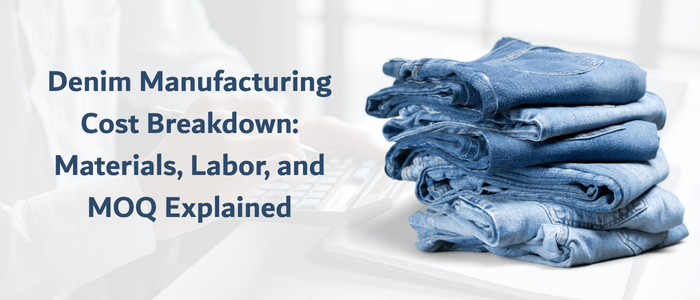
Denim never really goes anywhere. It cycles through trends, gets reinvented every few years, shows up in every category from luxury to fast fashion, and somehow keeps selling. For brands looking to launch or expand a denim line, which staying power is the appeal. But denim production is more expensive and more complex than most other types of pants, and that catches a lot of first-time buyers off guard.
The fabric is heavier. The construction requires more specialized labour. The finishing processes — washes, distressing, fading — add a cost layer that simply does not exist with most other apparel. Here is an honest breakdown of what drives denim manufacturing costs and where the smart spending decisions are.
Why Getting the Cost Picture Right Matters Before You Start
The brands that run into trouble with denim are not usually the ones who overspend on materials. They are the ones who build a retail price on a rough cost estimate, get the actual quote, and find the margins do not work. Or they skip sampling upfront and pay three times as much when the bulk run comes back wrong. Knowing your cost structure before production begins helps you price correctly, pick materials for the right market position, and avoid the surprises that kill early-stage denim projects.
Material Costs: Where It All Starts
Denim fabric is sold by the yard and priced by weight, fibre content, and construction. Those three factors alone create an enormous range in what you will pay per unit before a single stitch is sewn.
Raw denim is unwashed and untreated, with deep indigo that fades naturally with wear — premium-priced and appealing to a specific customer. Pre-washed denim arrives softer and more relaxed after at least one wash cycle, making it more commercially versatile and slightly easier to produce for.
Rigid denim is pure cotton with no stretch — classic and durable, but without the give modern consumers often expect. Stretch denim blends in elastane, typically 2%–5%, and costs more per yard. It also behaves differently on the cutting table and through the washing process, which affects downstream labour and finishing costs.
Premium and selvedge denims are woven on narrower shuttle looms that produce a tighter, more durable edge. Production is slower, yield per yard is lower, and end cost is significantly higher. Selvedge makes sense at a premium price point with an educated customer. For a brand launching a casual everyday line on a competitive budget, it is not the right starting point.
Trims and accessories are consistently underestimated. Rivets, buttons, zippers, pocket lining, stitching thread, labels, patches, hang tags, and packaging all add per-unit cost that stacks quickly. Custom-engraved hardware costs more than generic equivalents. None of these line items is large alone, but together they can shift your unit cost by several dollars at scale.

Labor Costs: More Intensive Than Most Apparel
Denim construction is not forgiving. Heavy fabric stresses machinery and stitching through multiple layers at seams and stress points requires more robust equipment and skilled operators. A basic five-pocket jean involves more assembly steps than most people expect, and each step carries a labour cost.
This is why finding a cut and sew manufacturer with specific denim experience matters. A facility that primarily produces lightweight garments may struggle with denim construction quality, resulting in skipped stitches, uneven seams, or hardware that does not sit properly. These are not aesthetic problems — they are durability issues that show up after a few months of wear and come back to the brand.
Regional differences in labour costs are real. US-based manufacturing costs more per unit than lower-cost regions, but it brings faster turnaround, easier communication, simpler logistics, and no import duties. Whether that trade-off makes sense depends on your brand’s timeline, volume, and cost ceiling.
Washing and Finishing: The Hidden Cost Layer
This is the part that surprises most brands entering denim for the first time. The raw garment off the production line is often just the beginning. What happens after can add anywhere from a couple of dollars to fifteen or more per unit depending on the complexity of the finish.
Stone washing tumbles garments with pumice to create a worn, softened look. Acid washing uses chemical bleaching agents for high-contrast fade effects. Enzyme washing is a gentler biological process that produces softness and a refined result without harsh chemicals — it tends to cost slightly more but delivers a cleaner finish.
Distressing and manual finishing — whiskers, hand-sanding at the knees, manual rips — involves craftspeople spending real time on individual garments. The more detailed and realistic the effect, the more labour hours, and the more it costs. A heavily distressed jean can easily add $8–12 per unit in finishing labour compared to a clean unwashed style.
Brands should define the exact finish they want before requesting quotes. Describing it as “vintage washed” will get three different interpretations from three different manufacturers. Specificity here saves money and prevents disappointment.
| Cost Component | Cost Impact | What Drives It | Budget Tip |
|---|---|---|---|
| Denim fabric (rigid) | Low–Medium | Weight (GSM), weave, fibre quality | Start here before moving to premium options |
| Stretch denim (elastane blend) | Medium | Elastane % and fabric width | Common expectation in modern denim lines |
| Selvedge / premium denim | High | Narrow loom construction, lower yield | Only justified at premium retail price points |
| Trims (buttons, rivets, zippers) | Low per unit, adds up | Generic vs branded hardware | Custom hardware adds $1–$3 per unit |
| Basic construction labour | Medium | Assembly steps, seam count, fabric weight | Clean styles reduce labour hours significantly |
| Manual distressing | Medium–High | Complexity of the finish, time per garment | Budget $5–$12 per unit for detailed distressing |
| Washing and finishing | Medium | Process type, number of wash cycles | Define finish precisely to avoid quote variation |
| Sampling (per style) | One-time | Design complexity, number of revision rounds | Budget $150–$400 per style; always do it |
MOQ and How It Reshapes Your Per-Unit Cost
MOQs exist because manufacturing has fixed costs that do not scale with order size. Pattern creation, marker making, machine setup, quality control — all of this happens whether you are producing two hundred pairs or 2,000. When those fixed costs are divided across more units, the per-unit contribution shrinks. For denim specifically, MOQs tend to sit slightly higher than lighter garment categories because fabric mills have minimum yardage requirements and denim production involves more setup time.
A brand working with a quality denim jeans manufacturer on a 500-unit run might pay $28–32 per unit on a basic five-pocket style. The same garment at 2,000 units might come in at $18–22. Neither number is wrong; they reflect different economies.
Startups often feel pressure to chase the lowest per-unit cost by committing to higher MOQs than they are ready for. That is usually a mistake. Unsold denim inventory, where fit and wash are personal preferences, is expensive to hold. Better to find a denim jeans manufacturer who genuinely supports lower minimums and build volume as the market confirms what is working.
Sampling: The Stage Nobody Should Skip
Denim sampling costs more than most other garments and takes longer. Wash development alone — getting the exact shade, types of jeans, and texture right — often requires multiple rounds. Budget $150 to $400 per style and plan for at least two rounds before bulk. What you are buying is fit confirmation, construction validation, and wash approval all at once. A five-pocket jean that fits wrong, seams that break after ten wears, or a wash that comes out a different shade than the reference sample is a return problem. The sampling cost is genuinely cheap compared to fixing any of those issues after bulk production is complete.
Shipping, Logistics, and Lead Time Costs
Denim is heavy. That is not a trivial point — shipping costs for international freight are calculated by both weight and volume, and a container of finished jeans weighs more than lighter garment categories. US-based manufacturing eliminates import duties and customs delays, provides faster turnaround, and makes it easier to catch and resolve production issues early. International production may offer a lower unit cost on paper, but freight, duties, delays, and the difficulty of real-time oversight often close that gap once everything is counted.
Cost vs. Quality: The Decision That Defines the Brand
In denim, quality is not abstract. Customers know within a few washes whether a pair of jeans was made well or cut to a price. The stitching either holds or it does not. The wash either looks intentional, or it looks cheap. The brands that build durable denim businesses invest in the right fabric from the start, sample properly, and work with manufacturers who understand the category. Saving $4 per unit on weaker fabric or skipping a sample round to hit a timeline tends to produce products that get returned or do not get reordered — the math on cheap shortcuts in denim rarely works out over a full production cycle.
How to Reduce Denim Manufacturing Costs Without Cutting the Wrong Corners
- Start with a cleaner design. Every pocket, panel, and decorative detail adds labour. A well-fitted five-pocket in quality denim outsells a complicated design in mediocre fabric every time.
- Define your finish in writing before quoting. Vague wash descriptions produce wide quote variations and expensive surprises. Reference samples or written specifications save time and money.
- Order strategically, not just cheaply. Chasing MOQs you are not ready for ties up cash in inventory. A higher per-unit cost at a manageable volume is often the better business decision on early runs.
- Use generic trims first. Custom-branded hardware is worth it when the product is proven. On a first run, standard quality rivets and buttons perform the same and cost less.
- Consolidate colourways. Each wash requires its own dye lot and potentially its own development round. Two or three strong options cost less to produce than six.
How Argus Apparel Approaches Denim Manufacturing
Denim requires a manufacturer with real category experience, not just general apparel capability. Fabric sourcing (especially for t-shirt fabrics), wash development, and construction quality in denim are specific skills. Argus Apparel supports denim brands through the full production chain — tech pack development, sampling, bulk production, and branded packaging — with a transparent approach to cost that shows brands where their budget is going rather than delivering a black-box quote. For startups, the flexible MOQ structure matters. Not every brand is ready to commit to 2,000 units of an untested wash. As a full-service denim jeans manufacturer, Argus Apparel works with brands at various stages of scale, which is a practical advantage when you are still learning what your customer wants to buy.
The Bottom Line
Denim manufacturing costs are higher and more layered than most apparel categories — fabric selection, construction complexity, wash development, order volume, and logistics all stack to produce the final number. But every one of those variables is manageable with the right information upfront. Budget honestly, sample without exception, define your finish specifications clearly before quoting, and find a manufacturer who will be straight with you about where the money is going. That is the combination that produces denim lines that work financially and perform well in the market.