Why Getting the Numbers Right Before Launch Saves More Than You Think
Baby clothes are among the repeat-purchase categories in the global apparel. Sizes fluctuate on a regular basis, gift registers are constantly being restocked, and parents will flock to a brand they know and trust. This is a good spot for startups and private label businesses, as it is a space that is loyal and continually in demand. If you are planning to build a custom baby clothing line, knowing what drives manufacturing costs before your first order protects your margins, your timeline, and your brand reputation from day one.
What Baby Clothing Manufacturing Actually Costs
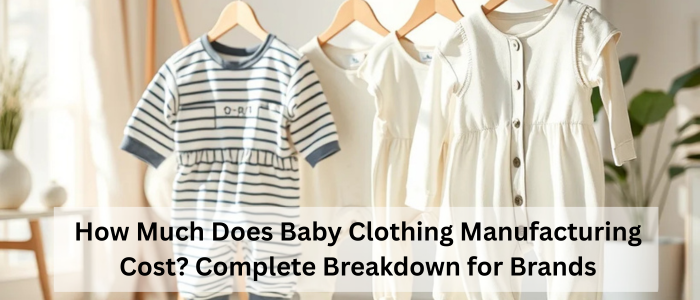
Baby clothes production is not sold by a fixed price since there is no fixed version of baby clothes. The cost of a basic cotton onesie produced in bulk is $2-$5 per unit. A high-quality romper that is made with premium organic materials, has soft labels that are branded, is compliance evaluated, and has coordinated packaging can cost $10 to $18. Seasonal collections, multi-piece sets and specialty fabrics drive up the price even more.
These ranges are since each production decision has an impact on the final number. Fabric selection, design complexity, order size, and compliance all have an impact. The key to being able to budget realistically and not be surprised by the factors that slow down brands in their first season is to understand each factor individually.
Fabric Is Where the Budget Lives
The cost of fabric in babywear is usually 30-45% of the garment’s total cost, and sometimes higher. Cotton blends fall in the mid-range price of $3-$6 per yard and are sturdy enough to be used for infant clothes that require a lot of washing. Organic cotton is more expensive, ranging from $7 to $12 per yard, and provides a premium positioning opportunity, and access to certifications that are becoming increasingly desired by retail buyers.
Bamboo fabric is becoming a popular choice for its softness and moisture absorbing properties; however, its price is higher than traditional cotton and it is important to source it correctly to ensure that it is not being marketed as a product with properties that it does not have. Fabrics in the middle range are called interlock and rib knit and they are workhorse fabrics for onesies, play sets and sleepwear due to their stretch and comfort against baby skin.
Choosing the material of babywear has implications other than the price. Parents are aware of the texture, breathability, and durability of the garment after 10 washes. Choosing the appropriate fabric also involves a production choice, a safety choice, and a brand positioning choice.
Custom Clothing Manufacturing Timeline: From Design to Delivery

Safety and Compliance: Costs That Cannot Be Skipped
Baby clothes are subject to more regulation than almost any other type of clothing. Brands in the United States are required to meet CPSC requirements for flammability, small parts, and drawstrings. There are multiple frameworks and overlapping requirements for each of the EU, Canadian and Australian markets, and different testing protocols are used.
The minimum is non-toxic dyes, double stitched seams, child-safe snaps and smooth edges and trims. The cost of third-party lab testing, which is used to certify compliance, will be $200 – $600 per style, in addition to your pre-production budget. Organic lines are more expensive but are increasingly required by retail partners and direct consumers, such as the certification OEKO-TEX STANDARD 100 or GOTS.
This is not where brands save money. Rigorous apparel manufacturing quality control is the cost of being taken seriously in this category. Brands that make apparel manufacturing quality control a fixed part of their production process build the kind of credibility that turns first-time buyers into repeat customers.
Challenges for Apparel Startups
Design Complexity: The Variable That Catches Brands Off Guard
Not all baby garments cost the same to produce, even when fabric is identical. A plain cotton bodysuit and a three-piece coordinated set both involve fabric and labour, but the cost gap between them is meaningful.
Printing methods introduce further variability. Screen printing is cost-efficient for cotton basics at volume but adds setup fees per colourway. Heat transfer printing handles short runs flexibly but raises breathability concerns on garments worn directly against infant skin. Planning seasonal ranges requires understanding how those variables change per-unit economics before any design is finalized.
Branding and Packaging: Small Details at Real Cost
Brand identity in babywear lives in the details. Soft woven labels replace printed neck tags because scratchy labels are one of the most common parent complaints. Hang tags, polybag packaging, custom box inserts, and branded tissue paper build the unboxing experience but add $0.50 to $2.50 per unit depending on specification.
Embroidery is used sparingly in babywear because heavy texture on garments worn against infant skin creates discomfort. When it appears, it is typically on outer-layer pieces. Screen-printed logo placement on basics remains the most cost-efficient branding option at volume.
Labor and Production: Where Expertise Pays Off
Labor costs vary by manufacturing region. Production in South and Southeast Asia typically falls between $1.50 and $4.00 per unit for a standard baby garment. Domestic US manufacturing costs more but offers faster turnaround and closer quality oversight for brands that prioritize both.
Choosing the right production partner matters as much as geography. Working with experienced cut and sew manufacturers who manage delicate fabrics and precise construction is an investment that pays off in product consistency. Babywear demands accurate snap alignment, correct sizing across every size run, and seam quality that holds through repeated washing. Skilled cut and sew manufacturers bring the technical discipline this category specifically requires, and the difference shows clearly in the finished garment.
Quality control and final inspection typically add 1% to 3% of total production value, a line item that should always appear in your budget rather than catch you off guard at invoice time.
MOQs and What They Do to Your Per-Unit Cost
| Order Volume | Approximate Per-Unit Cost (Basic Onesie) |
|---|---|
| One hundred units | $6 to $9 |
| 200 to 300 units | $4 to $6 |
| Five hundred units | $3 to $5 |
| 1,000+ units | $2 to $4 |
Minimum order quantities shape per-unit economics more than most brands realize early on. Most manufacturers set MOQs between 200 and 500 units per style per colourway. At lower volumes, fixed costs such as pattern making, sampling, and production setup are divided across fewer pieces, keeping per-unit costs high.
Moving into bulk apparel manufacturing unlocks meaningful price breaks on fabric, trims, and labour that change what your margins can realistically look like. Bulk apparel manufacturing at five hundred units or above is where the economics of a baby clothing line begin working in your Favor, though testing at controlled volume first remains the smarter approach for unproven styles.
Sampling, Shipping, and the Costs That Surprise First-Time Brands
Development sampling is mandatory in babywear. Fit, comfort, and safety all require physical validation before production scales. A development sample costs $150 to $400 per style, and most brands run two to three rounds before approving a final specification. These costs are not optional; they are the insurance policy against expensive production errors.
Coordination deserves a dedicated budget line. International freight, import duties, and packaging contribute 10% to 20% of total production cost for brands sourcing overseas. Those figures compound quickly if treated as afterthoughts.
Cost vs. Quality: Where the Real Trap Is
The lowest production quote and the best production outcome are rarely the same thing in baby clothing. Poor seam quality, unsafe trims, or fabric that fails after a few washes do not just generate returns. They damage brand trust in a category where parent word-of-mouth travels fast and negative reviews have lasting impact.
Brands that win in this space invest deliberately from the start. The per-unit cost of doing it right is always less than the downstream cost of doing it wrong.
How Argus Apparel Handles Baby Clothing Production
At Argus Apparel, private label apparel manufacturing for babywear starts with transparent pricing and a genuine commitment to safe, high-quality material sourcing. The team works with startups and growing brands building custom baby clothing collections at every scale, offering flexible MOQs that serve businesses still testing demand alongside partners running larger production volumes. Private label baby apparel manufacturing demands a manufacturer with the knowledge of compliance regulations along with craftsmanship, and this is just where Argus comes in. Each step of the development sample to full production runs is designed.
to be consistent, to communicate and to give the parents trust in the product from the first wear.
The Bottom Line on Baby Clothing Manufacturing Costs
There are numerous decisions that stack up to make up the cost of baby clothes. All these factors contribute to fabric selection. Each of these factors has an impact on fabric selection. Knowing how this work together prior to production will help you to price appropriately, safeguard your margins, and create a brand for babywear that parents will come back to again.