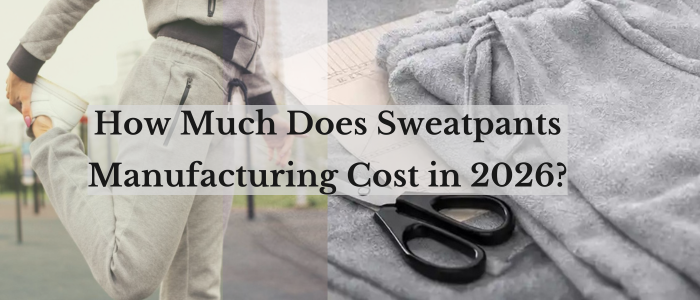
From lounge rooms to the catwalk, nobody thought sweatpants would become a real thing, did they? The fitness industry continues to grow, streetwear is showing no signs of stopping, and I cannot help but notice every online fashion brand with an aesthetically pleasing Instagram is adding a pair to their collection. So, if you have a napkin and a sketch or a mood board to match, and you are wondering what to expect to pay for your sweatpants in 2026, you are in the right place.
Good cut and sew manufacturing is what separates sweatpants that feel $20 from sweatpants that feel $80, even when the fabric is identical. A skilled cut and sew manufacturing partner will catch issues at the sample stage that a cheaper shop would miss until you have got 2,000 finished units sitting in a warehouse wondering why the inseams do not match.
Well, it depends. The price fluctuates with material selection, trim, volume, location and what have you. But that is not enough of an answer, so here is what helps determine your per unit cost, where all the cash goes, and how to create a budget plan you can stand up in front of a half-way through your next job.
Why Knowing Your Costs Actually Matters
If you do not know how much something costs, you cannot price it right. Sounds obvious. And yet so many young brands start out by sticking their hand out and then end up making margins that do not cover the cost of the stickers!
Once you see how all the numbers in the sweatpants cost equation add-up, a couple of things become clear. And when it is time to scale up, you know what categories you can and cannot play with.
The General Cost Range in 2026
A plain, no-frills pair of sweatpants produced in bulk typically lands somewhere between $6 and $14 per unit at the factory gate. A premium pair with heavyweight fleece, reinforced stitching, branded trims, custom packaging, and embroidery can climb to $18 or even $35 per unit without anyone being unreasonable.
The range is wide for good reason. Cotton prices keep bouncing, freight rates are still recovering from a messy few years, and several fabric mills raised prices twice in the last twelve months. Inflation is a real line item now, not a footnote. The bigger gap, though, sits between basic and premium construction. A cheap pair and an expensive pair often are not even the same category of product.
| Cost Factor | Typical Range (Per Unit) | Notes |
|---|---|---|
| Basic bulk sweatpants (no-frills) | $6 – $14 | Factory-gate price |
| Premium build (heavyweight fleece, reinforced stitching, branded trims, custom packaging, embroidery) | $18 – $35 | Different category of product |
| Fabric share of total cost | 30% – 45% | Largest single line item |
| Branding layer (woven labels, care tags, hangtags, logo polybags) | +$1.50 – $3 | Adds up despite small individual cost |
| Ribbed cuffs | +$0.20 | Per pair |
| Sampling/development | $50 – $150 per sample | Usually 2–4 rounds |
| MOQ impact (same style) | $22 at 50 → $12 at 500 → $9 at 2,000 | Most factories want one hundred–three hundred per style/colourway |
| Lead time (overseas) | 60 – 120 days | Plus, sea freight, duties, currency risk |
| Lead time (domestic) | Faster, smaller freight bills | Higher unit cost, fewer customs headaches |
Fabric Costs: The Biggest Chunk
The biggest part of your budget is likely to be fabric, typically 30-45 percent of total cost. These are the materials most sweatpants are made of:
Cotton is the most popular. Soft, breathable, and skin friendly. More expensive than polyester but customers can feel the difference on the first wear.
The winter workhorse is fleece. Spending a lot of money on a label is not a requirement, however it produces a hot, heavy, and good at concealing bad building. There is an enormous difference in the price range of midweight and heavyweight fleece.
French terry has gone “viral” as the athleisure sweetheart. Lightest in comparison to fleece, retains shape, and looks great in photos. It is a top choice among brands for summer to fall and fall to spring transitions.
Blends of polyester are the most economical option. Cotton/poly blends result in low per unit cost and offer extra durability, but they compromise some of the hand-feel of the natural fibre.
Next is GSM (g/cm2) which is nothing more than fabric weight. The weight of sweatpants falls in the range of 220 – 280 GSM. Heavy weight ones weigh more than four hundred. The heavier you are, the more material there will be per pair of you and the more you will spend. Pure mathematics, practical applications.
For a deeper look at how different fabric weights and textures behave, this hoodie materials guide covers cotton, fleece, and French terry in the kind of detail that transfers perfectly to sweatpants. The same hoodie materials guide logic applies when you are comparing mill quotes side by side.
Construction and Stitching
This is where quality either shines or falls apart, sometimes literally. Standard stitching is cheaper. Reinforced stitching, bar-tacking at stress points, and double-needle seams cost more in labour time but survive a lot more wash cycles.
Other construction details that quietly add up:
Elastic waistbands are cheap. Ribbed waistbands with interior drawcord channels are not. Drawstrings seem tiny but branded tipped ones cost a few times more than a plain round cord. Ribbed cuffs give that classic jogger look and add twenty cents per pair. Pockets are where things get interesting: basic side pockets are standard, while zippered pockets, cargo pockets, or hidden phone pockets each add hardware and labour cost.
Design Complexity
A simple pair of joggers with elastic top and bottom takes a fraction of the time compared to a tapered, panelled, zipper-pocket design with contrast stitching. Every extra panel means more cutting, more sewing, more quality checks. Custom sizing like extended ranges or specific fits adds pattern-making costs upfront.
This is also where fit trends play a role. Wide leg, stacked, baggy, slim, tapered, cuffed, cropped. Each one has different pattern requirements and different fabric yields. If you are still narrowing down your direction, it helps to see the full spread first. There’s a solid breakdown of the main types of sweatpants that clothing brands are producing right now, and studying the different types of sweatpants on the market makes cost conversations with a factory far more productive than showing up with a vague “something like Essentials but not really.”
Printing and Branding
A blank pair of sweatpants is not really your product. Your branding is.
Screen printing is the most common method and stays cheap once setup is done. Embroidery looks premium, lasts longer, and costs more because of thread time and digitizing fees. Heat transfer prints give you full-colour flexibility with a slightly lower durability trade-off. Puff prints and specialty finishes are having a moment in streetwear, and they are priced accordingly.
Then comes the branding layer most beginners forget to budget for: woven neck labels, printed care labels, hem tags, hangtags, polybags with your logo, box inserts. None of this cost much individually. All of them together can add $1.50 to $3 per unit, sometimes more if you go premium on packaging.
Labor and Production Costs
Labor depends heavily on where your factory sits. USA-made production carries a higher price point than overseas alternatives, but comes with faster turnaround, tighter quality control, and easier communication across time zones. Skilled operators managing reinforced seams, topstitching, and finishing details cost more than someone running basic straight-stitch lines. Quality control is another layer some factories skip entirely and others take seriously. The serious one’s charge for it. The ones that skip it cost you more in returns and re-prints.
MOQs and What They Do to Your Pricing
Minimum order quantities are the part every first-time founder finds frustrating. Most factories want to see at least 100 to 300 pieces per style, per colourway. The smaller your run, the higher your per-unit cost climbs.
Order fifty pairs and you might pay $22 per unit. Order five hundred of the same style and that pair could drop to $12. Order 2,000 and you are potentially looking at $9. Bulk economics are real, and they reward planning.
For a deeper walk-through of how minimums work across the industry, this guide to MOQ in clothing manufacturing covers negotiation angles most contemporary brands miss. Understanding MOQ in clothing manufacturing before you start conversations with factories will save you a lot of awkward back-and-forth about what is flexible.
Sampling and Development
Before bulk runs, you need samples. Usually two to four rounds, sometimes more. Each round costs money, often $50 to $150 per sample depending on complexity.
Yes, it feels like overhead. No, you should not skip it. A proper sample round catches a waistband that rolls, a cuff that is too tight, a drawstring that is too short, or a fabric that looks great flat and terrible on a body. Finding those issues after you have produced 1,000 pairs is an extremely expensive mistake to learn from.
Shipping and Logistics
Domestic production means faster shipping, fewer customs headaches, and smaller freight bills. Overseas production can cut unit cost significantly but stacks on sea freight, duties, lead times of 60 to 120 days, and some currency risk. In 2026, supply chain planning still matters more than it used to. Factories get booked solid around holiday seasons. Fabric mills run out of specific weights. Smart brands place orders earlier than they think they need to, and they always build in a two-to-four-week buffer for the things nobody can predict.
Cost vs Quality: What to Actually Weigh
Cheap sweatpants are easy to find. Good ones, less so. Cutting corners on fabric gives you a pair that pills after three washes. Cutting corners on construction gives you seams that pop after a weekend. Customers notice that reviews reflect it and returns quietly eat your margin.
Spending a few extra dollars per unit on fabric and finishing tends to pay back through repeat purchases. A brand that launches with quality gets remembered. A brand that launches cheap usually gets replaced by the next one.
Where Argus Apparel Fits In
If you are planning a launch, producing private label sweatpants with a transparent manufacturing partner makes the entire process less stressful. At Argus Apparel, we work with startups and scaling brands in the athleisure and casualwear space, with flexibility in our MOQs, as well as accurate fabric cost breakdowns, and a year of experience to back our fabric sourcing. Their private label sweatpants service is built for brands that care about details without needing to become fabric experts themselves.
Wrapping It Up
You do not have to guess at the manufacturing costs of sweatpants; it is easy once you understand what to pay attention to. Each of these factors, from fabric to complexity of construction, branding, labour, and order quantity plays its own part and if you change even one of these, then you change the number. The top brands of 2026 are not necessarily the most affordable. They are the ones who know where the money is going and use it to purchase items which customers can touch.