Not every brand needs to design from a blank page. That might sound counterintuitive, but it is true — and its exactly why private label apparel manufacturing has become such a popular entry point for clothing brands, ecommerce sellers, and entrepreneurs who want a real product in market without spending a year in development.
The idea is straightforward: instead of building a garment from scratch, you start from a manufacturer’s existing range, make it your own through branding and customisation, and sell it under your label. Of course, like any model, it comes with trade-offs. This guide covers everything you need to know about private label clothing manufacturing.
What Is Private Label Apparel Manufacturing?
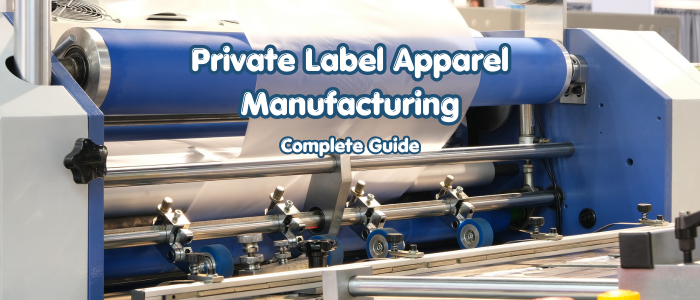
Private label apparel manufacturing is when a brand sells garments produced by a manufacturer under their own brand name. The manufacturer supplies the base product; the brand applies its identity — logo, labels, tags, packaging — and sells it as its own.
It is worth distinguishing this from white label. White label products are completely generic. Private label is a step further: the product may still start from an existing template, but there’s typically more scope for customisation.
The key thing to understand is that with private label, the apparel manufacturing process starts from somewhere that already works.
How Does Private Label Apparel Manufacturing Work?
The process is more structured than most people expect. Here is how it typically flows:
- Garment Selection
You browse the manufacturer’s range and select the styles that fit your brand direction — a relaxed-fit tee, a midweight hoodie, a zip-through fleece. At this stage you are assessing silhouette, construction quality, and whether the base garment matches what your customer would want to wear.
- Fabric & Colour Choices
Most manufacturers offer a selection of fabrics and colourways within each style. You are working within a defined range, but there’s usually enough flexibility to make it feel like yours — especially if the manufacturer supports custom dyeing or fabric upgrades.
- Branding Application
This is where your label goes on the garment. Woven neck labels, heat-transfer logos, screen-printed branding, custom hangtags, custom packaging — all of this gets applied to make the product distinctly yours. Done well, a customer would have no idea the base garment came from a shared range.
- Sampling & Approval
Before bulk production starts, you will receive a branded sample to review. Check the fit, the branding placement, the label quality, and the overall finish. Get this signed off properly — changes after bulk are expensive and slow.
- Bulk Production
Once the sample is approved, production runs. Because the base garment already exists and has been produced before, this stage moves faster than it would in custom manufacturing. Lead times are shorter, and the variables are fewer.
Private Label vs Custom Apparel Manufacturing
The most common question brands ask when they are getting started is which route makes more sense. Here is an honest side-by-side. You can also read our full guide to the custom apparel manufacturing process if you want to go deeper on the custom side.
| Private Label | Custom Manufacturing | |
|---|---|---|
| Design Control | Low — choose from existing silhouettes | High — built to your exact specs |
| Time to Market | Fast (weeks) | Longer (months) |
| Upfront Cost | Lower | Higher |
| MOQ | Lower | Varies; often higher |
| Brand Exclusivity | Limited | Full |
Neither option is universally better. Private label is built for speed and lower risk. Custom manufacturing is built for brands that need true differentiation and are willing to invest in it.
Advantages of Private Label Apparel Manufacturing
There is a reason private label has become the starting point for so many clothing brands. The advantages are real:
- Faster time to market. Without the full development cycle of custom manufacturing, you can have branded product in your hands in weeks rather than months. For trend-driven or seasonal collections, that speed is everything.
- Lower development costs. No tech pack development, no pattern making from scratch, no multiple sampling rounds. The bulk of the upfront investment in getting the garment right has already been done.
- Reduced complexity. You are not managing every variable of production. That frees up your energy to focus on branding, marketing, and selling — which is where most early-stage brands should be spending their time anyway.
- Lower MOQ risk. Private label often comes with lower minimum order quantities, which matters when you are evaluating demand and do not want to be sitting on excess stock.
- A real product, quickly. For influencers, merch brands, or entrepreneurs launching a first collection, private label gets a quality product into your customer’s hands while you figure out whether the market is there.
Limitations of Private Label Apparel
It would not be a useful guide if it only told you the good stuff. Private label has genuine limitations, and it is worth being clear-eyed about them before you commit:
- Limited exclusivity. The base garment you are using is available to other brands too. A competitor could be selling an identical product with different branding. If uniqueness is central to your brand proposition, that is a problem.
- Shared base designs. You are working within the manufacturer’s existing silhouettes and construction. You can influence the surface; branding, colour, finishing — but the underlying garment is fixed. Fit adjustments, construction changes, unique design features? Not usually on the table.
- Less long-term differentiation. Private label is a great starting point. As a permanent strategy for a brand trying to build a genuinely distinctive product identity, it has a ceiling. Most successful brands that start with private label eventually move toward cut and sew manufacturing as they grow and as their product vision becomes more defined.
Who Should Choose Private Label Apparel Manufacturing?
Private label is not for everyone, but for the right type of brand at the right moment, it is genuinely the smartest move. Here is who it tends to work best for:
- Startup fashion brands that want to launch with a real product without the cost and complexity of full custom development. Build your audience, prove the demand, then invest in going deeper.
- Influencers and content creators launching merch lines. Your audience already knows you — the product just needs to be excellent quality with your branding on it. Private label handles that efficiently.
- Ecommerce and DTC sellers evaluating a new category or niche. Lower upfront commitment means you can validate before you scale.
- Seasonal or trend-driven collections where speed to market matters more than product uniqueness. Hit the window while it is open.
- Brands between development cycles that need product to fill a gap while a custom range is in production.
Private Label Apparel Manufacturing Costs & MOQs
There is no single price for private label. But here is a general sense of the factors at play:
- Garment base price is dependent on classification. An essential tee will fall in another price range to a technical performance jacket.
- Branding adds cost. Embroidery, custom hangtag, printed packaging, woven labels, all of these are priced on a per-unit basis.
- MOQs are, in most cases, more affordable compared to custom. The reason so many of the private label programmes operate with minimums lower is that the basic garment already being manufactured. However, MOQs differ across manufacturers – learn more about the application of MOQ in apparel manufacturing to learn what to anticipate and how to make negotiations.
- Lead times are shorter. The fact that the garment is a reality and the production process is in place means that you are normally dealing with a quicker turnover than that of custom manufacturing.
Common Private Label Apparel Categories
There are many types of garments that it works with as a private label.
The most widely made categories are:
- T-shirts: The most popular to start with, they are currently sold in the most enormous variety of weights, fits, and fabric properties.
- Hoodies and sweatshirts: High demand all year round and there is a lot of diversifications in terms of weight, build, and finish.
- Activewear and performance items: Outpacing well, especially in retailers of health, fitness, and outdoor clothing.
- Loungewear: Sets, joggers, and coordinating matches that have become a trend and are not going anywhere.
- Polo shirts: A core product among brands in the corporate gifting, golf, and high-end casual sector.
How to Choose the Right Private Label Apparel Manufacturer
The choice of the manufacturer dictates it all, quality of the products, lead times, level of stress in your life and brand reputation.
And what does matter when making that call is this:
- Ask to be reminded to give samples prior to committing. Touch the cloth, put your fingers in, rub your shoulders, clean it, and examine it. Quality of the base garments is the limit to your product.
- When you are in the infancy stage, you must find a manufacturer that will cooperate with you with low volumes, not trying to portray you as a second-tier customer.
- The variety of branding is not the same with all manufacturers. See what they are capable of in-bedding itself: woven labels, embroidery, screen printing, custom packaging or what ends up outsourced.
- How quickly do they respond? Are they simple in explaining things? Do they make it known ahead or only when you enquire when a problem arises (and it will)?
- The location you place an order influences the price of your clothing as well as quality, lead time, and shipping. You need to know the entire picture and not the per unit price.
How Argus Apparel Supports Private Label Manufacturing
We’ve built our private label clothing service around what brands actually need — not what’s easiest for us.
Here is what that looks like in practice:
- Low MOQs. We work with startups and growing brands, not just established volume buyers. If you are evaluating a new category or launching for the first time, we will find a way to make the numbers work.
- Proper quality control. Every order goes through inline and final inspection. You will receive documentation, not just a box of garments and a hope that everything is fine.
- Full branding and packaging support. Woven labels, hangtags, custom packaging, embroidery, screen printing — we manage the branding layer properly, so your product feels like a product, not a blank with a sticker.
- Scalable production. Start small and build. As your volumes grow, we grow with you — same team, same quality standards, just bigger numbers.
- A team that communicates. You will have a dedicated point of contact who knows your brand and keeps you informed at every stage. No chasing, no guessing.
Find out more about what we offer at Argus Apparel — or just get in touch directly and we will take it from there.
Final Thoughts on Private Label Apparel Manufacturing
Private label apparel manufacturing is one of the most practical ways to get a branded clothing product into market — especially when you are earlier in your journey and want to evaluate demand before committing to full custom development. The speed, the lower costs, and the reduced complexity make it genuinely compelling for the right type of brand.
It is not a shortcut, and it is not forever. At some point, most brands that are serious about product will want more control than private label allows. The most important thing is being clear on what you are trying to achieve and choosing a private label clothing manufacturer who will execute it properly. Collaborate with the right partner, and private label can be the foundation a strong brand build on.
Thinking about starting a private label clothing brand? Let us talk.