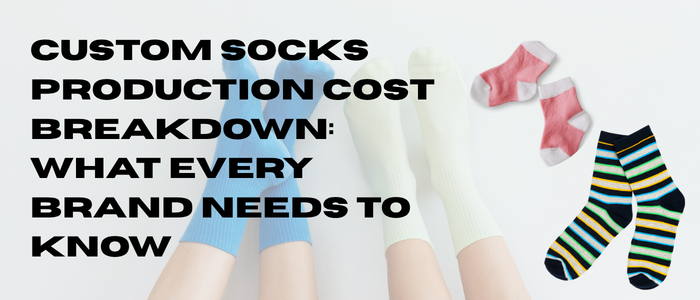
Socks. They appear easy, right? Six feet, a yarn, machine, finished. However, having attempted to procure the personalized socks to your brand, you are likely to realize that the truth of the matter is a little more complex than that. The world market of socks is developing rapidly, and both big and small brands are starting to realize how lucrative the insignificant product can be. Nevertheless, when there is no clear picture of the factors that cause production costs, it is all too easy to be caught by surprise by some unforeseen costs, shattered budgets, or suppliers who lack transparency in their pricing.
Whether you are a startup looking to launch your first collection or an established retailer adding socks to your lineup, this guide breaks down every cost factor involved in custom sock manufacturing, clearly and honestly. And if you are looking for a dependable partner who manages all of this without the guesswork, working with experienced custom sock manufacturers is one of the smartest moves you can make early in the process.
Why Understanding Socks Production Costs Actually Matters
The thing with not knowing your production costs is that it will appear later, and not in a satisfactory manner. The trend among the brands that fail to conduct the cost research phase includes either under pricing their products, selecting material cheaply that customers discern, or panhandling when the MOQ in clothing manufacturing sweeps their budget before they even open.
Average Cost of Custom Sock Manufacturing
No one fixed amount will be the cost of producing custom socks since the variables are unique to each brand. With that said, a rough estimate of the price of a custom knit pair of socks is between $1.5 and $6.00 per pair based on material, design complexity, ordered quantity and branding needs. Lower MOQs are inherently expensive to purchase per unit, whereas bulk purchases give economies of scale.
Material Costs: Where It All Starts
The base of any sock is the yarn, which is among the largest variable costs in the production. The kind of material that you use does not only influence the price but also comfort, durability, breathability, and the way your customers feel about the product.
The most typical one is cotton. It is also inexpensive, breathable, and easy to knit making it a favourite with everyday wear and fashion sock. Combed cotton is a level higher in quality and is a little more expensive, however, the soft feel is something that the customers can feel.
Bamboo is making a legitimate movement within the sustainable fashion sector. It is naturally antibacterial, unbelievably soft, and moisture-wicking, and you will pay a premium over cotton. Companies that position themselves either in the wellness or eco-friendly segment usually consider it worth the price.
Wool (and merino, in particular) is an excellent choice in performance and cold-weather socks. It is particularly good at regulating temperature, and it is Odor resistant, but it is priced higher. Good outdoor or athletic collections.
The blending of polyester and nylon is found in athletic socks since it gives them durability and stretch without many increases in the cost. They are not normally used as standalone but in combination with other fibres.
Knitting and Production Costs
Single colour or simple two-colour patterns on standard gauge machines are used in basic knitting. It is quicker, more effective, and less expensive. Perfect with solid-colour socks, plain stripes, or sports.
Jacquard knitting gets interesting to look at and is also costlier. It is a technique to provide detailed multi-colour patterns that are built into the knit structure. Imagine geometric patterns, cartoon images, or logos of brands embroidered all over the sock. The equipment is more complicated, the facility startup time is higher, and the price is higher in line with that.
Machine gauge is also involved. The finer, denser knit structures are made by higher gauge machine with more stitches per inch. This is normally applied to dress socks and high-quality fashion socks, with lower gauge machines common to thicker, casual, or athletic. The gauge required will depend on the target market and type of fabric.
Design Complexity and Its Cost Impact
The more complicated your design, the more expensive it is and it is not all about the knitting. The complexity of design affects all aspects of production, whether it is setup time, material waste or finishing details.
Simple crew socket made of one colour is easy and cheap to make. Include a printed pattern, compression areas, reinforced heels and toes, cushioning panels, or a distinctive cuff construction and each additional layer costs. Number of colours is important as well. Six or more-colour Jacquard patterns are much more expensive to set up and print than a two-tone design.
Branding and Customization Costs
Banded socks are not simply socks with a logo stamped on them. Branding reaches the label, the packaging, the hangtag and even the knit itself, done right. And there is a price attached to each of them.
The standard of any private label apparel manufacturing launch is woven labels and care tags. Custom packaging, be it a branded belly band, box or a polybag with your logo will cost but will also add perceived value. Packaging is also reacted to by retail buyers and end customers particularly when it comes to gift ready products.
Knit logos or brand names integrated into the sock design can be a high-end feel which can command a higher price, but it takes more set-up time and jacquard knitting facility. When you have a manufacturer with an established branding infrastructure in place, the price per unit of these extras is likely to be more acceptable than acquiring them singly. This is one of the areas where working with experienced private label clothing manufacturers pays off, because they manage the full package under one roof.
Minimum Order Quantities and How They Affect Your Cost
MOQ is a term all brands learn early, often just when they are trying to evaluate a new product and not invest their full budget in it. The reason there are minimum order quantities is that manufacturers require a minimum amount of order to offset the setup costs, machine calibration, and yarn sourcing.
Sampling and Development Costs
Before any bulk production run, you need a sample. This prototype lets you check fit,
accuracy, material feel, and design execution before you commit to a full order. Sampling is a non-negotiable step, and it carries its own cost.
Labor Costs in Sock Production
Manufacturers who build QC into their process are more dependable partners overall. This is also where a full-service approach, such as what you get from professional cut and sew manufacturers, makes a real difference in output consistency.
Shipping, Logistics, and Lead Times
Shipping costs are the variable that brands most often underestimate, and they can take a healthy margin and put a real dent in it if you are not accounting for them from the start.
Domestic manufacturing in the USA reduces shipping time and import duties but typically comes at a higher production cost per unit. Overseas sourcing can lower per-pair costs but adds freight charges, customs duties, and longer lead times that affect your inventory planning.
Cost vs. Quality: Finding the Right Balance
The temptation to cut costs wherever possible is understandable, especially in the initial stages of building a brand. But with socks, quality shortcuts tend to backfire in very public ways. A sock that pills quickly, loses its shape after a few washes, or has a rough feel will generate returns and negative reviews faster than almost any other product issue.
Custom Sock Production Cost Breakdown (At a Glance)
| Cost Component | Estimated Range (Per Pair) | Notes |
|---|---|---|
| Base Yarn / Material | $0.30 – $1.20 | Cotton, bamboo, wool, or blends |
| Knitting (Basic) | $0.20 – $0.50 | Simple patterns, lower gauge machines |
| Knitting (Jacquard) | $0.60 – $1.50 | Multi-colour, complex designs |
| Finishing & QC Labor | $0.15 – $0.40 | Linking, boarding, quality checks |
| Branding & Labels | $0.10 – $0.50 | Hangtags, woven labels, packaging |
| Sampling & Prototyping | $50 – $200 flat | One-time fee per design |
| Shipping & Freight | Varies | Depends on volume, origin, and destination |
How Argus Apparel Approaches Custom Sock Manufacturing
Argus Apparel works with brands at every stage of the custom sock journey, from helping source the right yarn for a specific end use to delivering finished, packaged pairs ready for retail. What makes the process work is transparency: pricing is clear, timelines are honest, and production quality is not negotiable.
Branding support covers labels, hangtags, and packaging as part of a full production package. And because custom sock manufacturers at Argus operate with an end-to-end model, you are not coordinating between separate vendors for production, branding, and shipping. One partner, one conversation.
Tips to Reduce Your Socks Production Costs
A few practical moves that can bring costs down without compromising the product:
✓ Start with fewer colourways. Launching in two or three colours rather than six cuts down setup and yarn costs significantly.
✓ Standardize your sizing range where possible. Fewer sizes mean simpler inventory and lower minimum requirements.
✓ Choose a yarn blend strategically. A cotton-polyester mix often gives you durability and comfort at a lower price than pure cotton or bamboo.
✓ Plan your order quantities with your manufacturer. Even a modest increase in MOQ can trigger a meaningful cost-per-unit reduction.
✓ Get your tech pack right before sampling. Revisions cost time and money. The clearer your specs upfront, the fewer rounds you need.
Wrapping Up
Custom socks are genuinely one of the more accessible and profitable product categories for fashion brands, retailers, and startups. But like any manufactured product, the cost picture is more layered than it looks from the outside.
If you are ready to move from planning to production, working with a manufacturer that brings clarity, quality, and flexibility to the table makes the entire process a lot less stressful and a lot more successful.
Each link should be used only once. Avoid linking the same page multiple times within a single blog.