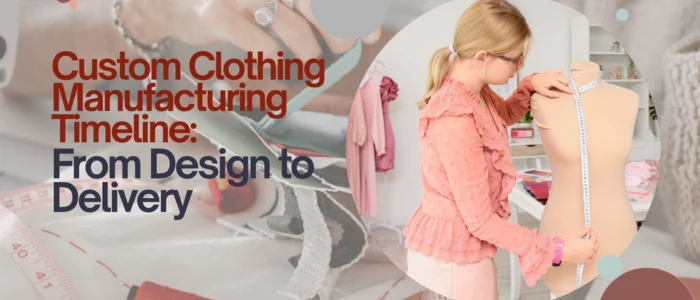
Timeline problems are behind most of the horror stories you hear from clothing brands. The collection that missed its launch window by three weeks. The Christmas stock that arrived in January. None of these situations are inevitable — but they are always the result of the same root cause: someone did not understand the custom clothing manufacturing timeline before they started, so they planned around the timeline they wanted rather than the one that was possible.
This guide fixes that. We will walk through every stage of the clothing manufacturing timeline with honest, realistic times — so you can plan your launches properly, have the right conversations with your manufacturer, and stop leaving your schedule to chance.
Overview of the Custom Clothing Manufacturing Process
Before we get into the individual stages, here is the shape of the full journey. Every custom clothing order moves through five broad phases, in this order:
- Design: Translating your idea into a technical document the factory can build from.
- Sampling: Building and approving a physical version of the garment before bulk production begins.
- Production: Cutting, sewing, and finishing your order at scale.
- Quality control: Checking the finished goods meet your approved standard before they leave the factory.
- Shipping: Getting the product from the factory to you.
Stage 1: Design & Concept Development
Typical time: 1–3 weeks
The starting point of every design to delivery apparel journey is getting your idea into a format that a factory can read. Design sketches and reference images are the beginning, but what the manufacturer needs is a tech pack.
One to three weeks sounds like a broad range, and it is. A straightforward tee with a single colourway and clean construction can be spec’d out quickly. Knowing your material direction early means sourcing can begin in parallel rather than waiting for design to fully close, which shaves time off the overall apparel production lead time when it matters.
Stage 2: Fabric Sourcing & Material Approval
Typical time: 1–2 weeks
Once your specs are clear, sourcing begins. This covers your main shell fabric, lining, trims — zips, buttons, drawcords, labels. If you are working with stock fabrics that the manufacturer already holds or can access quickly, this stage moves fast. If you are working with a custom fabric that needs to be specially woven, dyed, or ordered from a mill, it takes longer.
Colour approvals add time here too. If you are specifying an exact colour rather than matching from a stock range, the manufacturer will produce lab dip samples — small swatches dyed to your colour reference.
Fabric availability is one of the most common causes of slippage in the early part of any clothing manufacturing timeline, and it is one of the hardest to recover from later.
Stage 3: Sampling & Fit Approval
Typical time: 2–4 weeks
This is your chance to catch every problem before it is multiplied across your full order.
The clothing sampling timeline typically runs through two or three passes:
- Prototype sample: First physical version of the garment, sometimes in a stand-in fabric. You are checking construction and silhouette at this point, not finals.
- Fit sample: Made in the correct fabric, worn and assessed across your size range. This is where you identify fit issues, markup changes, and confirm the garment is doing what it is supposed to do.
- Pre-production (PP) sample: The final approved version the factory uses as the benchmark for bulk. Once you sign off on this, production starts — and changes become expensive.
Be responsive, be precise, and you will move through sampling efficiently. For more on how the broader process works, see our guide to the custom apparel manufacturing process.

Stage 4: Costing, MOQ Confirmation & Order Finalisation
Typical time: ~1 week
With samples approved, the commercial conversation closes out. Final pricing is confirmed based on your approved specifications, order quantities, and any finishing details that were refined during sampling. This is also when minimum order quantities are locked in — if you’re unsure how MOQs are typically structured, our guide to MOQs in apparel manufacturing is worth a read before this conversation.
Payment terms are agreed and a deposit is usually required to book your production slot. That last point matters more than most brands realise — factories run on fixed capacity, and a production slot is a real, finite thing.
Stage 5: Bulk Production
Typical time limit: 4–8 weeks
This is the longest stage of the custom clothing manufacturing timeline, and the one brands tend to underestimate. Four to eight weeks is a genuine range — a small, simple order in a quiet factory slot can move through quickly; a large, complex order during peak season will use every bit of that eight-week window and potentially more.
Bulk production moves through several sequential steps. Pattern grading scales your approved pattern across the full-size range before cutting begins. Fabric is then laid up and cut to the graded patterns. Cut pieces move to the sewing lines, where operators assemble them following the construction sequence from your tech pack. Any printing, embroidery, washes, or other treatments are applied, either inline or as a separate finishing stage depending on the technique.
Factors that affect where in that four-to-eight-week range you land include order size, construction complexity, how many embellishment techniques are involved, and current factory capacity. For a deeper look at what’s actually happening during this phase, our cut and sew manufacturing guide covers it in detail.
Stage 6: Quality Control & Packing
Typical time: 1–2 weeks
Quality control runs throughout production — not just at the end. Inline QC checks happen as the order moves through the sewing lines, catching issues before they compound. End-of-line inspection reviews finished garments against your approved PP sample: fit, stitching quality, measurement accuracy, print registration, label placement, and any visible defects.
Anything that does not pass is either repaired or pulled. You should receive documentation from final inspection — pass rates, any issues identified, how they were resolved. Packing follows inspection. Garments are folded to your spec, labelled, tagged, bagged, and boxed for shipment.
Stage 7: Shipping & Delivery
Typical time: 1–5 weeks
The final leg. Shipping timelines vary significantly depending on where the goods are coming from and how you are moving them.
- Air freight: Fast — typically five to ten days door to door for international shipments. Significantly more expensive per unit, but the right call when timing is critical or order volumes are smaller.
- Sea freight: Cost-effective for larger orders, but the lead time is real — three to five weeks from port to port, plus customs clearance at both ends. Plan for the full window, not the optimistic version.
Once goods are in transit, tracking is shared and delivery is confirmed on arrival. The order is complete, and the full apparel production lead time clock stops.
Total Custom Clothing Manufacturing Timeline: Summary
Here is the full custom clothing manufacturing timeline briefly. These are realistic working ranges — not best-case scenarios:
| Stage | Typical Time |
|---|---|
| Stage 1: Design & Concept | 1–3 weeks |
| Stage 2: Fabric Sourcing & Approval | 1–2 weeks |
| Stage 3: Sampling & Fit Approval | 2–4 weeks |
| Stage 4: Costing & Order Finalisation | ~1 week |
| Stage 5: Bulk Production | 4–8 weeks |
| Stage 6: QC & Packing | 1–2 weeks |
| Stage 7: Shipping & Delivery | 1–5 weeks |
| Total | 10–25 weeks |
Factors That Affect Your Clothing Manufacturing Timeline
Understanding where delays typically come from helps you prevent them. These are the variables that move the needle most:
- Design complexity. A highly constructed garment with multiple fabric panels, intricate detailing, and specialised hardware takes longer to sample and longer to produce than a straightforward cut-and-sew basic. Price and timeline both reflect complexity.
- Fabric availability. Stock fabrics move quickly. Custom fabrics — special colours, commissioned weaves, performance materials from specific mills — introduce lead time before production even begins.
- Number of revision rounds. Each sampling revision adds time. Two revision rounds are typical; more than that usually signals either an unclear tech pack or unclear feedback from the brand side.
- Order size. Larger orders take longer to cut, sew, inspect, and pack. This is straightforward, but it is often not factored into planning.
- Production location. Where your manufacturer is based affects both production timelines and shipping time. Domestic manufacturing is faster to ship but typically comes at a higher per-unit cost. Overseas manufacturing offers cost advantages but means a longer coordination tail.
- Factory capacity. A factory with an open slot can start immediately; a fully booked factory means you are queuing. The best manufacturers fill up. Book your production slot as early as possible.
How to Speed Up Your Clothing Manufacturing Timeline
Most timeline delays are avoidable. Here is what makes the difference:
- Submit a complete, accurate tech pack from the start. This is the single biggest lever you have. A properly documented garment produces fewer sampling errors, fewer revision rounds, and fewer questions from the factory floor. If you are unsure how to build one, work with your manufacturer’s team before submission rather than learning through failed samples.
- Respond to approvals quickly. Every day you sit on a sample approval, or a costing confirmation is a day added to your timeline. Build internal sign-off processes that move fast and treat approval requests as time-sensitive.
- Use stock fabrics where possible. If custom colour and fabric are not essential to your product identity, stock fabrics cut weeks off your sourcing stage. Sometimes that trade-off is worth it.
- Communicate clearly and consistently. Revision feedback that’s vague or contradictory creates extra sampling rounds. Be specific about what needs to change and why and confirm that the factory has understood before they start reworking.
- Book your production slot early. Do not wait until sampling is complete to have the production conversation. The earlier you secure your slot, the less likely a delay at one stage cascades into a missed window at the next.
How Argus Apparel Manages Clothing Manufacturing Timelines
A lot of timeline problems come down to one thing: manufacturers who are not straight with clients about what is possible. Here is what that looks like in practice:
- Dedicated production planning. Every order gets mapped against real factory capacity. You know your slot, your milestones, and your delivery window from the moment production starts.
- Transparent communication throughout. If something is running ahead or behind, you hear it from us before it becomes a problem — not after. Regular updates, clear documentation, no surprises.
- Scalable production capacity. Whether you are running a small test order or scaling into larger volumes, we plan capacity around your growth, not just your current order.
- Realistic lead times, always. We do not tell you what you want to hear. We tell you what is achievable — and then we work to hit it.
You can read more about our full production process in our guide to choosing the right clothing manufacturer.
Final Thoughts: Planning Your Clothing Brand Timeline
The brands that launch on time are not the ones with the simplest products or the smallest orders. They are the ones that understood the custom clothing manufacturing timeline before they started planning and built their schedules around reality rather than optimism.
Every stage of the clothing manufacturing timeline exists for a reason. Design feeds sampling. Sampling feeds production. Quality control protects everything that came before it. Shortcutting any stage does not save time overall. Choose a manufacturer who tells you the truth upfront.
Know your launch date? Let us work backwards from it.