It is Not as Simple as It Looks
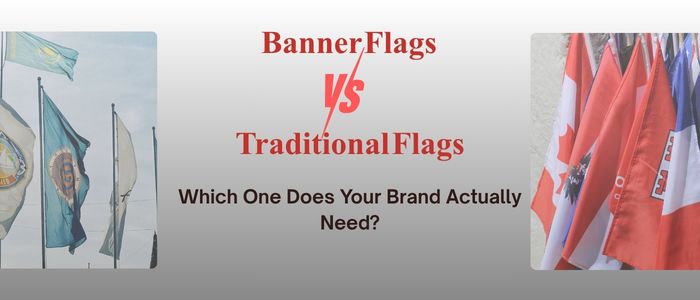
Here is a conversation that happens more than you would think. A business owner calls to order flags for an upcoming trade show. Halfway through the conversation it becomes clear they were picturing something completely different from what they asked for. One person says ‘flag’ and means a feather flag snapping in the wind outside a car dealership. Another says ‘flag’ and means a rectangular branded panel mounted on a pole in a corporate lobby. Both are right. Both are flags. And they serve entirely different purposes.
What Banner Flags Are
Banner flags are the ones you see doing the most work in high-traffic promotional environments. The long vertical panels outside a new restaurant. The curved feather flags flanking a trade show booth. The teardrop-shaped display outside a gym on a Saturday morning. They are built to move, to attract, and to be noticed by someone passing at speed.
What makes them specifically banner flags is their orientation toward marketing rather than identity. They are not saying, ‘this company exists here.’ They are saying, ‘something is happening here, right now, come look.’
What Traditional Flags Are
Traditional flags are the rectangular ones mounted on flagpoles outside corporate headquarters, universities, government buildings, hotels, and institutions. They usually come in standard proportions — 3:5 is common — and they are designed to represent rather than to advertise.
The intent is different. A traditional flag is not trying to stop foot traffic or announce a sale. It is saying: we are here, this is who we are, and we have been here long enough to have a flag. That kind of permanence carries its own brand signal, and for the right businesses, it is exactly the signal they want to send.
They also require a different kind of installation. Most are attached to fixed or semi-fixed poles, either wall-mounted brackets or freestanding flagpole systems. They are not going anywhere. Which, again, is the point.
Where They Actually Differ
On the surface, both are fabric with a brand on them. But the differences go deeper than shape.
Design and silhouette: Banner flags use shape as a design element. The curve of a feather flag, the pointed tip of a teardrop — these are not arbitrary. They make the flag distinctive from a distance, giving it a visual identity before anyone reads the logo. Traditional flags work within a rectangle. The design must do all the work because the shape will not.
Purpose and audience: Banner flags are outward facing in an active, urgent way. They are designed for people who have not decided to engage yet. Traditional flags speak to an audience that already arrived — employees, clients, visitors, passersby with enough time to notice what is on the building.
Portability: A set of banner flags fits in the back of a car, sets up in under five minutes, and can move from a Monday trade show to a Saturday retail event without any fuss. Traditional flags are planted. That is not a weakness, but it is a commitment.
Visual energy: Banner flags move. Even on a slow day, the fabric shifts and draws the eye in a way that static materials do not. Traditional flags move too, but in a different register — stately, measured, not urgent. The energy is fundamentally different and serves different brand moments.
Quick Comparison
| Feature | Banner Flags | Traditional Flags |
|---|---|---|
| Shape | Feather, teardrop, vertical | Standard rectangle |
| Primary Purpose | Promotions, events, retail | Branding, identity, formal display |
| Portability | Lightweight, pack-and-go | Fixed or semi-fixed |
| Visual Impact | Dynamic, movement-driven | Classic, formal presence |
| Setup Time | Minutes | Varies; often permanent |
| Best Environment | Trade shows, pop-ups, retail | Corporate offices, institutions |
| Lifespan Expectation | Seasonal / per campaign | Long-term, years |

The Case for Banner Flags
If your brand lives in events, retail, pop-ups, or any context where you are competing for attention against a crowded environment, banner flags are the tool you need.
The setup speed alone is worth something. When you are managing a trade show booth, exhibition stand, or outdoor activation, you do not have time for complex installation. A custom banner flag goes up fast and comes down the same way. Same flag, different city, two days later.
The shape options add a creative dimension that traditional flags do not offer. Feather flags have a softness and height that makes them visible from a real distance. Teardrop flags hold their shape in wind better than many alternatives. Straight vertical banners offer a clean, architectural look that works well against building facades or in structured exhibition environments.
And for campaigns with specific messaging — a seasonal sale, a product launch, an event with a fixed end date — banner flags let you be specific. You are not printing something you will use for ten years. You are printing something that is exactly right for this campaign, at this moment, for this audience.
The Case for Traditional Flags
Traditional flags make the most sense when permanence is the message.
Corporate campuses use them because they signal stability and established presence. Hotels use them to create an arrival experience that feels considered and formal. Institutions — universities, embassies, sports clubs — use them because they communicate belonging to something larger and longer-lasting than a single promotion.
Durability is another factor. A well-made traditional flag, printed on quality outdoor fabric with proper UV protection, will hold up through years of weather that would retire several generations of promotional banner flags. The economics work differently when the item is a permanent installation rather than a campaign tool.
There is also an aesthetic argument. For brands in sectors where formality and authority matter — financial services, legal, government, luxury — a feather flag outside the front door would feel wrong. A properly mounted, properly proportioned corporate flag sends exactly the right signal to the right audience.
How to Decide Which One You Need
Choose banner flags when: You are running a timed campaign, attending an event, trying to drive foot traffic to a retail location, or need something that travels. If the goal is to make a moment happen, banner flags are the tool.
Choose traditional flags when: You are establishing permanent outdoor branding, kitting out a corporate office or institution, or representing your brand in a formal or long-term context. If the goal is to say who you are rather than what you are doing right now, traditional flags are the answer.
Consider both when: Your brand has both a fixed home base and an active events or retail presence. The two types complement each other more than they compete. A corporate flag outside your office handles permanent identity. Custom banner flags handle everything that moves.
Other Factors Worth Considering
A few practical considerations tend to get overlooked in the flag selection process:
Location matters more than people realize. Indoor environments call for varied materials and mounting hardware than outdoor ones. Indoor banner flags can use lighter fabrics and do not need UV protection. Outdoor anything — banner or traditional — needs fabric and inks rated for sustained sun exposure and moisture.
Budget and quantity interact. Banner flags tend to be ordered in small runs for specific campaigns. Traditional flags are often ordered once and maintained. Neither is inherently more expensive; the cost models just work differently over time.
What Argus Apparel Brings to This
At Argus Apparel, the work covers both sides of this conversation. Banner flag production for events, retail, and campaigns. Traditional flag production for corporate installations, institutions, and long-term outdoor branding. The same quality standards apply to both.
That means dye-sublimation printing with genuine colour accuracy on banner flags — the kind that holds up when your logo is on a 12-foot feather flag and being judged at 50 feet. And it means proper outdoor-rated materials for traditional flags that survive years of real-world conditions rather than fading out after one season.
The customization capability runs deep in both categories. Non-standard sizes, specific hardware configurations, double-sided printing, short runs for targeted campaigns, bulk orders for multi-location rollouts. If the brief is specific, the production should match it.
Both Are Right. The Question Is Right for What.
The banner flags vs traditional flags debate does not have a universal winner. That is not a cop-out — it is just the reality. They solve different problems, signal different things, and work in different environments.
What matters is being honest about what you are trying to accomplish. If you need something that moves with your brand, travels to events, and performs in a competitive visual environment, banner flags will do that better than anything. If you need something that stakes a permanent claim and communicates institutional weight, traditional flags are the right call.