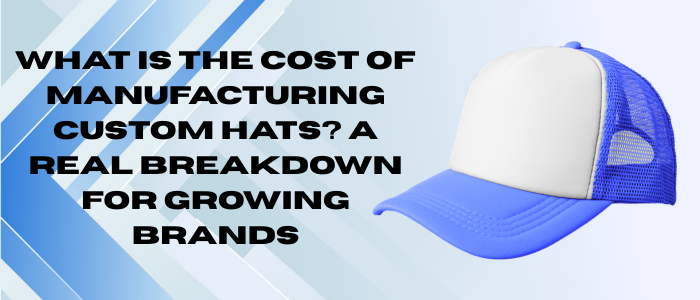
Custom hats have emerged to be one of the most successful fashion and merchandise products without being advertised. You will see them in every streetwear shop, merch page or at a music festival. They travel well, they get fretted in public and they provide a brand with a product that has a sort of marketing effect.
But here is what trips up a lot of contemporary brands: diving into production without understanding the cost structure. One misunderstood line item and your margins collapse. This guide breaks down every major cost factor in custom hat manufacturing, from materials to MOQ in clothing manufacturing and freight, so you can plan smarter and go to market with a number with which you can work.
Partnering with experienced custom hat manufacturers before your first order can save you from a whole lot of expensive surprises.
Why Understanding Hat Manufacturing Costs Matters
Your manufacturing costs impact all the following: your retail price, your margin, whether it makes sense for you to promote it without losing money, and whether the product is financially worthwhile for you in the long-term. When the production bill comes back from the printers, too many new brands are caught off guard by the bill being twice as high as they thought, only to discover that embroidery setup, inner labels and international freight were all on different lines to their checklist of items.
When you see the complete picture of the cost of the item you are sourcing, you make better decisions on what you are sourcing. You select materials that go with your budget. You do not make your customer mad at you for putting something on that he or she cannot afford at retail. You enter producer discussions with the questions on your mind.
Average Cost of Custom Hat Manufacturing
There is no flat rate here. Any supplier who gives you a single price without asking about your style, material, or quantity is not one you want managing your production. That said, a ballpark helps.
Basic unstructured styles like dad hats or simple snapbacks with one-location embroidery typically land between $4 and $10 per unit at reasonable quantities. Mid-range structured caps with added construction complexity sit around $10 to $18. Premium builds using wool blends, woven patches, and custom inner taping can push past $20 per unit depending on order size. The hat itself is rarely the biggest cost driver. It is everything layered on top of it.
| Cost Factor | Typical Range (Per Unit) | Notes |
|---|---|---|
| Basic unstructured (dad hats, simple snapbacks, 1-location embroidery) | $4 – $10 | Cheapest tier; less material, simpler assembly |
| Mid-range structured caps | $10 – $18 | Added construction complexity |
| Premium builds (wool blends, woven patches, custom inner taping) | $20+ | Cost scales with order size |
| Domestic vs. overseas labour | +$3 – $8 | Premium for US production |
| Sampling/development | $50 – $200 per sample | One-time, before bulk run |
| MOQ impact (same hat) | $15 at 50 units → $7.50 at 500 units | Economies of scale |
| Lead time (overseas) | 60 – 90 days | Sea freight, customs, tariffs apply |
| Lead time (domestic/nearshore) | 3 – 5 weeks | Higher unit cost, faster turnaround |
Material Costs in Hat Production
Your fabric type sets the foundation for both the product quality and the unit price. The most common materials in hat production are cotton twill for everyday caps, polyester blends for lightweight performance styles, mesh panels used in trucker hats, and wool or acrylic blends for structured caps and beanies.
Higher-quality fabrics increase your per-unit cost, but they also change how the product is perceived. A hat that holds its shape, feels substantial in hand, and wears well after a hundred washes builds brand trust. A cheap, floppy version does the opposite.
Hat Styles and Their Cost Differences
Not all hats cost the same to produce. The construction method, the number of panels and hardware are all factors. Dad hats tend to be the cheapest of them all due to less material and less complicated assembly. Snapbacks and trucker hats are in the middle. The reinforced front panels, buckram backing, and defined brims in structured baseball caps make them more expensive due to the additional components and tighter tolerances. The variety of beanies is diverse in terms of yarn weight and any ornamentation.

Customization and Branding Costs
It is at this stage that many brands end up blowing their budgets without knowing. Each detail that you add to a hat is money, and it adds quickly.
The gold standard of hats is embroidery which is charged per stitch. A back-hit, clean front-panel logo is cheap. Multi-location, 3D puffs embroidery or tonal stitching drive up the price. Structured styles can be screen printed, but less frequently. Patch designs such as woven, leather and PVC features give it a truly high-end appearance but they cost the same.
Design Complexity
Simple designs are your friend when you are watching costs. A two-colour embroidered logo with clean lines is dramatically cheaper to produce than a six-colour, multizone design with specialty thread and unusual panel shapes. Design complexity affects not just decoration fees but also labour time per unit, and that time gets factored into your price.
When working with custom hat manufacturers, ask them to walk you through how each design decision affects unit pricing. Good factories will do this transparently, and the conversation often helps you find ways to simplify without hurting the look of the product.
Labor and Production Costs
Labor is one of the less glamorous line items but a significant one. Hat production involves cutting fabric panels, sewing them together, attaching sweatbands and brims, adding hardware, and running embroidery or print decoration. Each step requires skilled workers and machine time.
Many brands benefit from working with manufacturers that offer cut and sew manufacturing as a fully integrated service, handling everything from pattern cutting through final quality checks in one facility. This reduces the chance of errors slipping between vendors, keeps your oversight simple, and results in more consistent runs.
Domestic production in the US costs more per unit than overseas, but it brings real advantages: faster turnaround, easier communication, and better-quality control visibility. The price difference can run $3 to $8 per unit depending on style complexity. Cut and sew manufacturing done domestically is worth exploring if consistency and lead time matter as much to you as unit cost.
Minimum Order Quantities (MOQs)
MOQs frustrate every brand at the start. Factories set minimums because small runs cost more per unit to set up, run, and manage. The economics of scale apply hard in manufacturing: ordering fifty hats might cost you $15 each, while ordering 500 of the same hats could bring that down to $7.50. That gap has big implications for your retail pricing and profit margin.
For brands evaluating a modern design before committing to volume, look for partners that specialize in private label hat production with startup-friendly MOQs. Some manufacturers are built to work with smaller initial orders, which lets you validate a style and evaluate the market before locking into a large run.
Sampling and Development Costs
Never skip sampling. It is the most critical quality control measure before large-scale production and it is the step that is skipped by brands that end up with five hundred of a hat where the colour is incorrect, the brim is misshapen, or the embroidery is puckered.
Depending on complexity, sample fees are usually between $50 and two hundred per sample. That price will buy you a prototype that is ready to print to check colour, structure, size, and finish before a bulk order is finalized. Include this in your budget. It is not a choice whether you are concerned with what turns up at your door.
Shipping and Logistics
It costs you to ship whether you produce at home or overseas. Sea freight, customs fees, import tariffs, and broker fees are often the costs of international production of bulk orders. The domestic production does not need most of that complexity and has higher unit cost of production.
Lead times are also important. The order to delivery can be 60-90 days overseas manufacturing. The domestic or nearshore partners take a time of 3 to 5 weeks to deliver. When you have a firm date of launch, that difference is important and must be considered in your clothing line business plan prior to commitment to a supplier and not afterwards.
Cost vs. Quality: Getting the Balance Right
It is tempting to go with the lowest cost of production option, and it is especially so when margins are already tight. but cheap hats tell it. The stitching loosens. The brim becomes distorted with a couple of wears. The embroidery puckers. When a customer gets a poor-quality hat, he/she is not going to use it, so there will be no brand exposure and a high probability of negative review.
Brands that establish a continuous recognition invest in quality at the beginning. It does not imply spending as much as possible. It is being tactical in the places you make things simpler, such as smaller SKUs or more minimalistic designs, and places where you do not compromise such as materials, quality of stitching and finishing details. Thoughtful private label hat production done right puts your brand on heads people want to keep on. That is the whole point.
Argus Apparel’s Approach to Hat Manufacturing
Argus Apparel is a manufacturing company based in Los Angeles that collaborates with startups, street brands, and emerging labels on custom headwear and apparel. Their hat production involves end to end production of materials, sourcing, sampling, embroidery, inner labelling and packaging that are ready to be sold in retail stores and all this under one single team and pricing is transparent with the ability to adjust MOQs depending on the brands which are yet to determine their volumes.
For brands thinking beyond headwear, Argus also supports custom apparel manufacturing across multiple product categories, making it easier to consolidate your supply chain as your line grows. If you are exploring custom apparel manufacturing for a broader collection or just starting out with hats, their team can walk you through cost breakdowns, design specs, and production timelines without requiring you to figure it all out on your own.
Conclusion
The price of personalized hats is not an exact price. It is a stratified assembly of materials, construction technique, design sophistication, customization processes, quantity of order and coordination. All that equation works into what you pay per unit and what you can realistically charge retail.
Realizing the entire picture of costs before you get into the market is how you determine prices that make sense, secure your margins, and create a brand that does not run out of runway during the second production run. Do the math early. Budget for samples. Choose materials to suit your position. And deal with a supplier who will make you familiar with all the lines on that invoice before you will sign it.