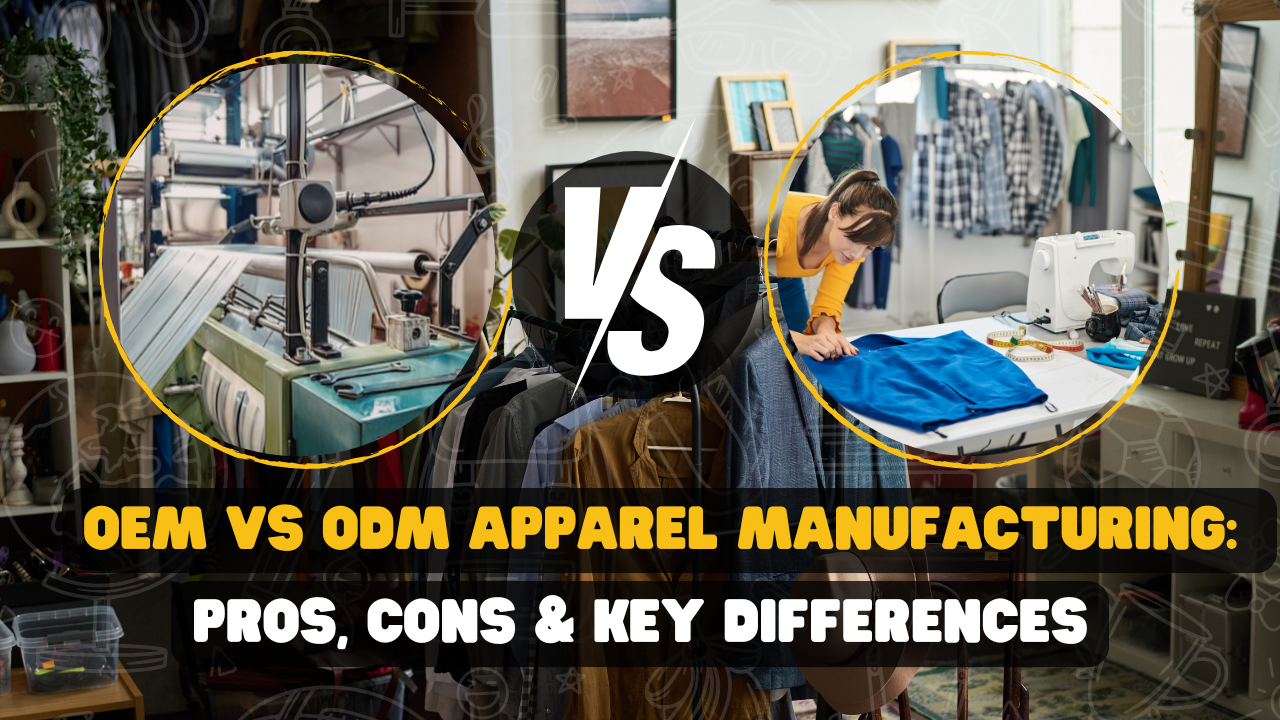
If you have spent any time researching clothing manufacturers, you have certainly come across the terms OEM and ODM. They appear constantly — on manufacturer websites, in sourcing guides, in factory profiles — and they are used in ways that are sometimes contradictory, occasionally interchangeable, and often just confusing.
That confusion is not just semantic. Choosing between OEM and ODM apparel manufacturing has real consequences for your brand: how much control you have over your product, how quickly you can get to market, how much you are spending upfront, and how distinctive your garments end up being.
This guide cuts through the noise. We will define both models clearly, compare them honestly, and help you work out which one — or which combination — makes sense for where your brand is right now.
What Is OEM Apparel Manufacturing?
OEM stands for Original Equipment Manufacturer. In the context of clothing, it describes a manufacturing model where the brand supplies everything — the designs, the tech packs, the construction specs, the trims, the measurements — and the manufacturer’s job is to produce it accurately.
The creative and technical work lives with you. The factory is executing your vision, not contributing to it. This is essentially what most people mean when they talk about fully custom or cut and sew apparel manufacturing — you own the design, you own the outcome, and the manufacturer brings the skills and infrastructure to build it.
OEM is the natural home for brands that take their product seriously. Fashion labels with a distinct aesthetic, premium brands where construction details matter, and any business that needs its garments to exist nowhere else on the market. The trade-off is that it demands more from you upfront — in time, in investment, and in the quality of your technical documentation.
What Is ODM Apparel Manufacturing?
ODM stands for Original Design Manufacturer. Here, the manufacturer is the one doing the design work. They develop a range of base garments — silhouettes, constructions, fits — and brands come in to customise the surface layer: branding, colourways, labels, tags, packaging.
If OEM apparel manufacturing is building a house from your own blueprints, ODM is moving into a well-built house and making it feel like yours. The structure is already there. You are choosing the paint, the fixtures, and putting your name on the door.
ODM is closely related to what most people call private label. The core appeal is speed and simplicity: you are not solving product development from scratch, which means you can move faster and spend less before you know whether the market is there.
OEM vs ODM Apparel Manufacturing: Key Differences
Here is a direct comparison across the factors that matter most when you are deciding between the two models:
| OEM | ODM | |
|---|---|---|
| Design Ownership | 100% the brand’s | Manufacturer’s base |
| Customisation | Full — built from scratch | Limited to branding/finish |
| Time to Market | Longer (months) | Faster (weeks) |
| Dev Costs | Higher | Lower |
| Brand Exclusivity | Fully exclusive | Shared base design |
| IP Control | Brand owns all IP | Manufacturer retains design |
| Best For | Established / premium brands | Startups / fast launches |
The pattern is clear: OEM apparel manufacturing gives you more control and more exclusivity but demands more investment and time. ODM apparel manufacturing trades some of that control for speed and accessibility. Neither is inherently better — it depends entirely on what stage you are at and what you are building toward.
Pros and Cons of OEM Apparel Manufacturing
Advantages of OEM
- Full design control. Every detail of your garment — the fabric, the construction, the fit, the finish — is yours to define. Nothing is borrowed from a shared template.
- Strong, exclusive brand identity. Your product exists nowhere else. A customer who wants what you make can only get it from you, which is a genuinely powerful position to be in.
- Purpose-built products. Because you control the spec, you can engineer exactly the right garment for your customer — not a close approximation of it.
- Ideal for premium and fashion-driven brands. When your product is a core part of your brand value, OEM is the model that lets you protect and develop it properly.
Disadvantages of OEM
- Higher development costs. Tech pack creation, pattern making, multiple sampling rounds — these all-cost money before a single unit of bulk production begins.
- Longer lead times. From concept to bulk production, the custom apparel manufacturing process takes months, not weeks. If timing is your primary concern, OEM requires planning well in advance.
- You need solid technical documentation. A weak tech pack produces weak results. OEM only works well when the brand side of the equation is properly prepared.
Pros and Cons of ODM Apparel Manufacturing
Advantages of ODM
- Faster route to market. Because the base garment already exists and has been produced before, you are skipping the most time-consuming parts of product development. Weeks instead of months.
- Lower upfront investment. No tech pack development, no from-scratch pattern making, no multiple prototypes rounds. The development cost has already been absorbed by the manufacturer.
- More accessible for startups. Lower MOQs and simpler processes make ODM clothing manufacturing the more realistic starting point for brands that are still finding their feet.
- Lets you focus on brand-building. Less time on product development means more time on the things that drive early growth: marketing, community, content, customer experience.
Disadvantages of ODM
- Limited design uniqueness. The base design is available to other brands. With good branding you can make it feel distinct, but the underlying garment is not exclusive to you.
- Less brand exclusivity long-term. As your brand matures and product becomes a more central part of your identity, the limitations of working from a shared template become more constraining.
- Design IP stays with the manufacturer. Because you did not create the base garment, the design belongs to them. You are licensing a version of it, not owning it outright.
OEM vs ODM vs Private Label: What is the Difference?
This is where a lot of brands get tangled up, so it is worth being direct about it.
ODM and private label are closely related — so much so that they are often used interchangeably. Technically, private label is the broader commercial model (selling manufacturer-produced goods under your brand name), and ODM describes the manufacturing structure that usually underpins it. In practice, if a manufacturer tells you they offer ODM, they certainly offer private label. Same product, different terminology.
OEM and custom cut and sew are also near-synonyms in the apparel space. OEM is the term common in manufacturing and sourcing contexts; “custom” or “cut and sew” is how it is typically described in brand-facing conversations. If you are asking a non ODM clothing manufacturer to build from your designs, you are doing OEM.
The models overlap in practice too. A manufacturer might produce your core range as OEM and supply an ODM-based capsule collection on the side. A brand might start with an ODM base and gradually introduce OEM pieces as their product vision develops. The categories are useful for understanding, but they are not rigid walls.
Which Manufacturing Model Is Best for Your Brand?
Honestly? It depends on where you are. Here is a straightforward way to think through it:
If you are a startup or doing a test launch:
ODM is certainly the right starting point. Lower costs, faster timelines, and less complexity let you validate demand without betting the whole operation on a product that has not been evaluated in market. Get your first orders, understand your customer, and build from there.
If you are a growing brand with some traction:
A hybrid approach often makes sense. Keep some core styles running on an ODM basis while you start developing OEM pieces that represent where your brand is heading. This lets you manage cash flow and timelines while starting to build a genuinely exclusive product range.
If you are an established brand with a clear product identity:
OEM is the model that protects and expresses what you have built. You have done the work to understand your customer and your product, you have the resources to invest in development, and you need garments that belong entirely to you. Full custom is the right call.
Can Brands Use a Hybrid OEM + ODM Model?
Yes — and more brands do this than you might think. The idea that you have to commit fully to one model or the other is not how manufacturing works in practice.
A common and sensible pattern is to start with ODM and scale toward OEM. Your first collection runs on ODM: faster, cheaper, lower risk. You learn what sells, what your customer wants, and how your brand fits into their life. That information shapes your OEM investment — you are building custom product around things you already know work, rather than guessing.
The most important thing is that your manufacturing strategy reflects your brand strategy — and that means it should evolve as the brand does. Staying on ODM forever because it is comfortable, when your product identity demands something more, is leaving brand value on the table. Refer to how MOQs factor into scaling your production when you’re thinking through the transition.
How Argus Apparel Supports OEM & ODM Manufacturing
We work across both models — and across the space in between. Whether you are building from scratch or starting from a proven base, the support structure is the same:
- OEM and custom cut and sew. We build from your designs, your tech packs, and your specifications. Full production management, inline quality control, and dedicated communication throughout — from first sample to final delivery.
- ODM and private label. Access our existing range of base garments, customise branding and finishing to your spec, and get to market faster. More detail on our approach in the private label apparel manufacturing guide.
- Low MOQs, scalable production. We work with brands at every stage — from first runs to established volumes. You are not expected to be a big buyer to get proper attention.
- Quality control built in. Inline and final inspection on every order, regardless of model. You will know what has been checked and how.
- Sourcing support. From fabric selection to trim sourcing, we help you make the right material choices for your product, your brand, and your budget.
Final Thoughts on OEM vs ODM Apparel Manufacturing
OEM apparel manufacturing and ODM apparel manufacturing are not competing philosophies — they are tools, and the best brands know when to use each one. OEM gives you ownership, exclusivity, and full creative control. ODM gives you speed, accessibility, and a lower barrier to entry. Both have a legitimate place in a smart brand’s manufacturing strategy.
The right manufacturing model is the one that aligns with your goals right now and leaves room to evolve. If you are trying to figure out where that line is, working with an experienced OEM clothing manufacturer — one that understands both sides of the equation — makes that decision a lot easier to get right.
Not sure whether OEM or ODM is the right fit for your brand?