Shorts are everywhere right now. Athletic brands, streetwear labels, DTC startups, loungewear companies — everyone seems to be adding a shorts line to the mix, and honestly, it makes sense. They’re versatile, they sell across seasons depending on how you position them, and they tend to have strong repeat-purchase rates when the customer likes the fit.
But the moment you start asking manufacturers what it costs to produce them, the answers get vague fast. “It depends.” “Send us your specs.” “Pricing varies.” All technically true, none of it useful when you’re planning a budget for your first production run. So, here’s a more direct breakdown of what drives costs, where the money goes, and what you can do to spend it smarter.
What the Numbers Generally Look Like
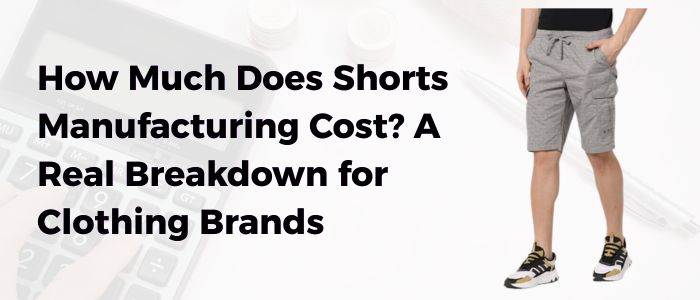
Wide-ranging as it sounds, production costs for custom shorts typically fall somewhere between $5 and $25 per unit at the manufacturing level, before branding, shipping, or markup. Basic cotton casual shorts with minimal construction sit toward the lower end. Athletic shorts with functional features — moisture-wicking fabric, inner linings, embroidered logos — sit toward the higher end. Premium performance styles can push past that range.
Several distinct variables stack on top of each other, and each one shifts the number. Understanding which variables move the needle most is where most brands find their first real budget clarity.
Fabric: The Biggest Single Cost Driver
Nothing affects the base cost of a pair of shorts more than the material it’s made from. And the choice isn’t just about price — it’s about what your customer needs the product to do.
Cotton is typically the most affordable option and remains popular for casual and loungewear fabric types. It’s breathable, familiar to most consumers, and easy to source. The downside is that it doesn’t perform well in moisture-heavy environments — it absorbs sweat rather than wicking it, which rules it out for athletic applications.
Polyester and poly-blend fabrics cost a bit more but offer properties cotton simply can’t. Moisture-wicking, quick-dry, stretch recovery, UV resistance — these are the fabrics behind most athletic and performance shorts. If your customer is wearing them at the gym, on the trail, or during competition, you’re almost certainly looking at polyester or a spandex blend.
Premium and specialty fabrics — things like four-way stretch technical blends, recycled performance materials, or high-thread-count natural fibres — push costs noticeably higher. For a brand positioning itself at a premium price point, this is often the right call. For a brand launching a basic casual line on a tight budget, it’s usually worth building toward this in later runs rather than right away.
Design Complexity and What It Costs in Labor
Whether you’re looking at different , trendy shorts, or even something as simple as a buttoned-up denim, design complexity completely changes the game.
A simple elastic-waist short with two side seams and no pockets is about as basic as production gets. It’s fast to cut, fast to sew, fast to finish. Add pockets — functional pockets, not decorative ones — and you’ve just increased your cut-and-sew time. Add a zippered pocket, and you’ve added a hardware component plus the labour to install it correctly. Side panels in a contrasting fabric? That’s more pattern pieces, more cutting, more assembly steps.
This is where working with an experienced cut and sew manufacturer matters more than many first-time buyers realize. The same design executed by two different production facilities can come out with meaningfully different quality — and cost — depending on how well they handle construction complexity. A manufacturer with real experience in shorts production can often flag design elements that add cost without adding customer value, which is a conversation worth having before the patterns are finalized.
Printing, Branding, and the Details That Add Up
Most brands want their shorts to carry some form of branding. That’s fine and expected — it’s how you build recognition. But it’s worth being clear on what each branding method costs.
Screen printing is cost-effective at volume. Setup costs are fixed, so per-unit price drops significantly as order size climbs. For a large run with a logo on the left thigh, it’s typically the smartest call.
Embroidery adds texture and a premium feel that holds up well through heavy washing. It’s more expensive per unit and complex logos cost more than clean, simple marks — keep the design tight to keep costs reasonable.
Sublimation printing bonds dye into the fabric and handles all-over graphics on polyester beautifully. It’s the standard for bold athletic designs but doesn’t work on cotton, which is worth knowing before you select your fabric.
Beyond the printing itself: woven labels, hang tags, branded drawstrings, and retail packaging all add small per-unit costs that stack quickly. Budget for these explicitly — they’re easy to underestimate.
MOQ: Why Order Size Changes Everything
Minimum order quantities (MOQs) exist because manufacturing has fixed costs — pattern setup, fabric cutting templates, machine calibration, quality control procedures — that don’t disappear just because the order is small. When those fixed costs are spread across 5,000 units, the per-unit contribution is tiny. When they’re spread across 100 units, it’s significant.
This is why smaller orders almost always carry a higher per-unit cost. It’s not the manufacturer padding margins; it’s the math of fixed costs. A brand ordering 500 units of a basic short might pay $14 per unit. The same short at 2,000 units might come in at $9. Neither number is wrong — they reflect different order economics.
For startups and smaller brands, the smart move is usually to find a custom shorts manufacturer that genuinely supports lower MOQ in clothing manufacturing rather than one that technically allows small orders but prices them punitively. The difference in per-unit cost is worth the time it takes to find the right partner.
| Cost Factor | Budget Range Impact | Notes | Startup Tip |
|---|---|---|---|
| Basic cotton fabric | Low | Affordable, casual use only | Good starting point for non-athletic styles |
| Performance poly blend | Medium | Ideal for athletic or activewear lines | Pairs well with sublimation printing |
| Simple design, no pockets | Low | Fewer construction steps = faster production | Best for tight first-run budgets |
| Multi-pocket, panelled design | Medium-High | More labour, more pattern pieces | Justify with a premium price point |
| Screen printing (logo) | Low at volume | Fixed setup cost, cheaper per unit at scale | Best for runs of 300+ units |
| Embroidery | Medium | Premium look, durable finish | Keep logo design simple to control cost |
| Sampling round | One-time cost | Typically, $100–$300 per sample style | Non-negotiable — always sample before bulk |
| Labels, tags, packaging | Low–Medium | Often underestimated by first-time buyers | Budget $0.50–$2 per unit for branding elements |
Sampling: The Cost Nobody Wants to Pay but Everyone Should
Before committing to bulk, you need a sample. Usually more than one. Sampling typically costs somewhere between $100 and $300 per style. That feels expensive relative to the unit cost, but it’s cheap relative to the alternative: discovering a fit issue, construction problem, or colour that came out wrong after committing to a full run. Think of sampling as insurance. It’s also where you catch things you didn’t know to look for until you hold the physical product in your hands.
Shipping and Logistics: The Final Cost Layer
Domestic US manufacturing has a real logistical advantage. Shorter lead times, no customs delays, no import duties. The per-unit cost might be slightly higher than overseas alternatives, but once you add international shipping, lead time risk, and potential customs holds, the total picture often looks different than the initial per-unit number suggested. International sea freight can take six to ten weeks post-production. Express air freight solves timing but hits the per-unit economics hard.
Where It Makes Sense to Spend and Where It Doesn’t
The areas worth prioritizing fabric quality (customers feel this directly), construction and stitching (determines how long the product lasts), and fit (the single biggest driver of returns and repeat purchases). Get that right and the product has a real chance.
The areas where early-stage brands can be more flexible: elaborate packaging, wide colour ranges, complex branding details. Get the product itself right first and build the presentation layer as the brand and margins scale.
Ways to Bring Costs Down Without Hurting the Product
- Start with a simpler design. A clean, well-made basic short with a strong fit often outperforms a complicated design with poor construction. You can add features in later runs when you’ve established the customer base and the budget to support it.
- Consolidate your colour options. Each colourway typically requires its own dye lot and sometimes its own fabric purchase minimum. Two or three colours to start is smarter than six.
- Plan for scale from the beginning. Even if your first run is small, structure your relationship with the manufacturer so that increasing volume in future runs reduces your per-unit cost. A good manufacturer will work this into the conversation upfront.
- Get your design files production-ready before you approach manufacturers. Back-and-forth over design specs adds time, and sometimes cost, to the sampling phase.
- Understand the full cost, not just the unit price. Ask explicitly about sampling fees, setup charges, labelling costs, and packaging before comparing quotes. Two manufacturers with similar per-unit prices can end up at very different total costs once everything is counted.
What Argus Apparel Does Differently
One thing first-time buyer often comment on is how difficult it is to get a straight answer on pricing before committing to a manufacturer. Argus Apparel approaches this differently. As a custom shorts manufacturer with experience across athletic, casual, and streetwear categories, their team walks brands through the actual cost drivers specific to their project rather than giving a generic range and asking for specs first.
Their private label manufacturing service covers the full production chain — tech pack development, sampling, bulk production, branding, and packaging — which means brands aren’t stitching together multiple vendors and losing cost visibility in the gaps between them. For startups especially, that kind of end-to-end clarity is worth a lot when you’re trying to plan a launch without surprises.
The Short Version (No Pun Intended)
Shorts manufacturing costs are real and meaningful, but they’re not mysterious once you understand what’s driving them. Fabric choice, design complexity, order volume, sampling, branding, and shipping all stack together to produce your total unit cost. Each one can be managed — but only if you know what to look for.
Budget honestly, sample without exception, plan for scale even if you’re starting small, and find a manufacturer who’s willing to be transparent about where your money is going. That combination tends to produce better products and fewer expensive surprises.